This is a practical guide to finding your own caffeine cut-off. It’s for people who fall asleep fine but wake up unrefreshed, and who suspect the afternoon coffee might matter more than they thought.
The six-hour caffeine rule may be too late
You have a coffee at three, you’re asleep by eleven, and you conclude caffeine doesn’t affect you. That’s a reasonable conclusion. It may also be wrong.
The six-hour rule is usually traced to Drake and colleagues (2013, Journal of Clinical Sleep Medicine). Their result is rarely quoted accurately. A small group of healthy sleepers took 400 mg of caffeine at bedtime, three hours before, or six hours before. Even at six hours, an in-home sleep monitor recorded more than an hour less total sleep. The study found six hours was too late, not that it was safe.
Two caveats belong here. 400 mg is a large dose taken all at once, and the group was small. So the honest reading is narrower than "six hours is fine" or "never drink coffee after breakfast." Caffeine can disrupt sleep well after you’ve stopped feeling it, and you may not notice.
That’s the part worth sitting with. Caffeine blocks adenosine, the sleep-pressure signal that builds through the day. You can fall asleep on that pressure anyway and still get shallower, more broken sleep. Falling asleep easily tells you very little about what happens after.
By the end of this guide, you’ll know your real daily dose and have run a structured test. That gives you a cut-off based on how you actually feel.
What you’ll need
- A notebook or notes app. A paper sheet by the bed works well because it keeps your phone out of the morning.
- The labels on everything caffeinated you consume regularly.
- Two fairly ordinary weeks. Avoid travel, a deadline crunch, or a new baby in the house.
- No tracker required. If you already wear one, the steps below explain what it can and can’t contribute.
Steps
1. Make a caffeine dose ledger for a typical day. Write down every caffeinated thing you have on a normal day, with the time and the amount. "A coffee" isn’t an entry. A small drip coffee and a large cold brew aren’t the same thing. According to the US Food and Drug Administration, an 8 oz cup of brewed coffee typically contains about 80–100 mg. Energy drinks range roughly 40–250 mg per 8 oz, and cans are often bigger than that.
Include the sources people forget: tea, cola, pre-workout, dark chocolate, and some headache tablets. Pre-workout is the one that surprises people most, so read the label rather than guessing. If a product doesn’t list caffeine, write "unknown." Don’t guess a number.
It worked if you can write a rough daily total in milligrams, and the time of your last dose.
2. Decide your measures before you start. Write them at the top of the page now. If you choose them after a few nights, you’ll find whatever you’re hoping for. Keep it to four:
- How refreshed you feel on waking (1–5)
- How many times you remember waking
- Afternoon energy (1–5)
- Roughly how long it took to fall asleep: quick, average or slow
Rate them within a few minutes of getting up, before looking at any app.
It worked if the same four questions are written down and you don’t change them mid-test.
3. Days 1–4: record your usual pattern. Change nothing. Drink as you normally do, keep your usual wake time, and fill in the ledger and ratings daily.
It worked if you have four days of normal-life baseline, including the bad nights.
4. Days 5–9: move your last dose two hours earlier. Keep your total roughly the same. Shift the afternoon cup earlier rather than dropping it. This keeps the timing question separate from the withdrawal question.
It worked if your total in milligrams stayed similar while the last dose moved.
5. Days 10–14: move it two hours earlier again. Same rules. Same total, earlier finish, same ratings.
It worked if you’ve completed all three blocks with the ratings filled in.
6. Compare averages, not single nights. Look at each block’s average morning rating and waking count. One rough Tuesday is noise. If the later blocks are noticeably better, keep the earliest cut-off that felt good. If nothing changed, caffeine timing may not be your main issue, which is also useful to know.
It worked if you can name a cut-off time, or rule timing out, based on two weeks of notes.
Common mistakes
Letting a tracker decide. Consumer sleep trackers estimate sleep stages from movement and heart rate. They don’t measure them the way a lab does. Night-to-night swings in "deep sleep" are often the device’s error, not a change in you. Chasing a better score during this test invites orthosomnia, the term Baron and colleagues (2017) used for anxiety and sleep trouble driven by tracker data. If you wear one, treat total sleep time as a loose pattern and leave the stage graphs alone. Our sleep-tracker accuracy piece goes deeper on what the numbers can bear.
Cutting total intake at the same time. If you drop cups instead of moving them, expect withdrawal headaches. They typically start within a day or so, and the research (Juliano & Griffiths, 2004) describes them lasting up to around a week. They’re predictable and short-term, but they’ll muddy your ratings. Move the cut-off first, then reduce slowly if you want to.
Treating "I’m just a fast metabolizer" as settled. Individual variation is real. Caffeine is broken down mainly by the liver enzyme CYP1A2, and its half-life varies a lot between people. Oral contraceptives and pregnancy slow clearance considerably. So does reduced liver function. Smoking speeds clearance, which means quitting smoking can make the same coffee hit harder and last longer. Variation is a reason to test, not a reason to skip the test.
Practical tips
If the afternoon cup is more about ritual than alertness, a swap can help. Half-caf keeps some of the lift. Decaf keeps the cup itself. Decaf isn’t zero: the FDA puts typical decaf at a few to around 15 mg per 8 oz.
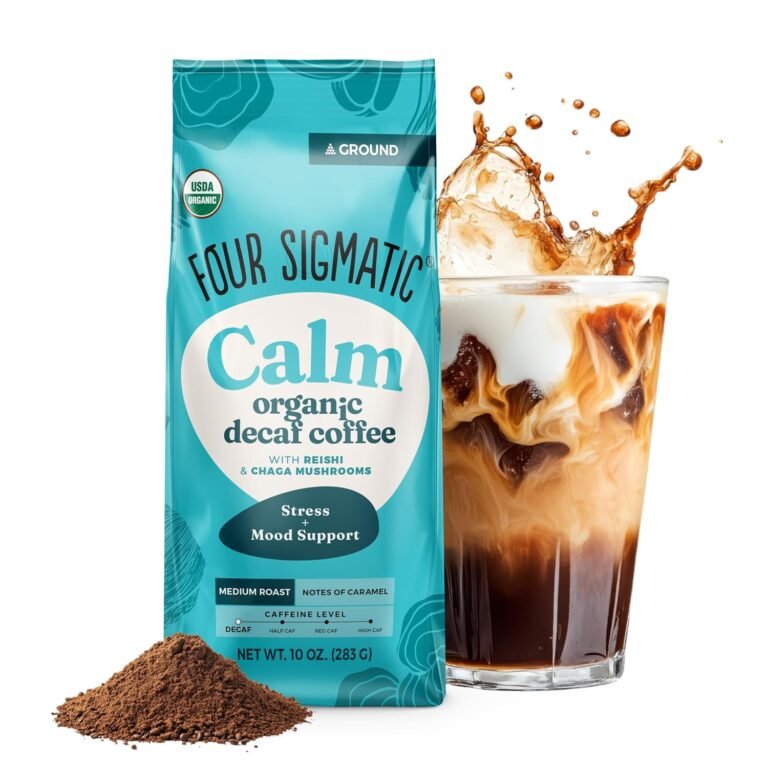
One option is Four Sigmatic’s Calm decaf. It’s Swiss Water Process decaf Arabica with reishi and chaga extracts, and the manufacturer says it contains under 5 mg of caffeine per serving. Choose it for the low caffeine, not the mushrooms. I wouldn’t expect those to do anything for your sleep. Any decent decaf does the same basic job.
Four Sigmatic
This coffee is for people who enjoy drinking coffee but want to keep caffeine intake very low. It can be used in the morning, afternoon, or evening when someone wants a coffee ritual without the caffeine level of conventional coffee.
Affiliate link — we may earn a commission, at no extra cost to you.
Morning light and a consistent wake time make whatever cut-off you land on work better. If you’re tuning caffeine for focus too, our Cognitive Performance piece on caffeine and L-theanine comes at the dose from the other direction.
FAQ
Short answers to what people ask most about caffeine timing and sleep.
When changing caffeine timing will not be enough
You should now be able to add up your real daily caffeine dose and run a fair two-week test. You’ll end it with a cut-off you trust, without quitting coffee.
Timing is one input, though, not a cure. Persistent insomnia, loud snoring or gasping that might point to apnoea, and sleep problems during pregnancy or in children belong with a clinician. Adjusting your coffee won’t solve those. I spent a stretch of years sleeping badly, and moving my coffee earlier helped a little. It wasn’t the whole answer, and pretending it was would have kept me from asking for help sooner.
You don’t have to sort this out tonight. Start the ledger tomorrow and let two weeks of notes do the deciding.
FAQ
How long before bed should I stop drinking coffee?
There’s no single number. Drake et al. (2013) found that a large dose six hours before bed still cut sleep by more than an hour. Many people do better with an earlier cut-off, and a two-week test is the most reliable way to find yours.
Why does caffeine affect my sleep if I fall asleep fine?
Caffeine blocks adenosine, the signal behind sleepiness, but you can still fall asleep on built-up tiredness. The disruption tends to show up later in the night as lighter or more broken sleep, which you may only notice as feeling unrefreshed.
Does decaf have caffeine?
A little. The FDA puts typical decaf at a few to around 15 mg per 8 oz cup. That’s far less than regular coffee, but it isn’t zero if you drink several.
Can my sleep tracker tell me whether caffeine is hurting my sleep?
Not reliably. Consumer devices estimate sleep stages rather than measure them, and night-to-night differences often fall within their error. Use your own pre-chosen morning ratings instead, and avoid chasing a score.
Will moving my cut-off earlier give me headaches?
It shouldn’t if you keep your total dose the same and simply drink it earlier. Headaches usually come from cutting total intake, and they typically ease within about a week.