If you wake at three or four in the morning damp, irritable and kicking one leg out from under the duvet, this is a guide to fixing that in sequence — free adjustments first, bedding second, and an actively cooled topper only if you genuinely need the top rung.
Introduction
Almost every article about sleep temperature gives you a number and stops. The number isn’t wrong, exactly, but it’s the least useful part of the answer — because the air temperature of your room is only one of four or five things determining how warm you actually are at 3am.
This guide is for people sleeping badly in warm rooms: small flats, top-floor bedrooms, houses with no air conditioning, couples who disagree about the duvet, and anyone who bought a memory-foam mattress and discovered it holds heat. It covers what the evidence supports about heat and sleep, why the famous 18.3°C figure is stated with more precision than it deserves, and a costed ladder from free to expensive — with a plain statement of who needs the expensive rung and who doesn’t.
Overview
Three things to hold in mind before the detail.
Sleep begins with a drop in core body temperature. You don’t fall asleep and then cool down; cooling is part of how sleep gets going, and it happens largely by dumping heat through the skin of your hands and feet. Anything that blocks that heat loss makes sleep harder to start and easier to break.
You are regulating the microclimate under the duvet, not the room. The air a thermostat measures and the air two inches from your skin are different environments. This is why two people in the same bedroom can have completely different nights.
The sequence matters more than the spend. Change what you sleep under, then what you sleep on, then — only if those fail — buy something with a plug on it. Most people stop improving somewhere in the first two rungs, which is a good outcome, not a disappointing one.
Core sections
The best bedroom temperature for sleep is a range, not a magic number
Most sleep guidance lands somewhere around 16–19°C for adults, and that’s a reasonable place to aim. What the research actually supports is narrower than that sounds: within a moderate band, and with bedding and nightwear that suit it, healthy sleepers do fine. Push meaningfully above that band — particularly with high humidity — and sleep gets worse in measurable ways.
The range exists because people differ. Age, body composition, what you wear, what you sleep under, whether the air is moving, and how humid the room is all shift where your personal comfortable point sits. A range is not a hedge. It’s the honest shape of the finding.
Why heat disrupts sleep
In their review of thermal environment and sleep in the Journal of Physiological Anthropology, Okamoto-Mizuno and Mizuno summarise what lab studies have found consistently: heat exposure increases wakefulness and reduces slow-wave sleep and REM sleep, and humidity makes the effect worse by limiting how well sweat can evaporate. They also make the point that matters most here — cold exposure is largely buffered by bedding and clothing, while heat is much harder to buffer, and it is the bed microclimate rather than the room air that best predicts how the night goes.
That matches what I used to see on overnight studies. A too-warm sleeper doesn’t usually wake up fully and remember it. They surface briefly, many times, and report in the morning that they slept badly without being able to say why.
You are cooling a body, not just a room
As bedtime approaches, blood vessels in your hands and feet widen and shed heat. Your extremities get warm so your core can get cooler. That’s the mechanism, and it explains two things that otherwise sound contradictory.
First, sticking a foot or an arm out from under the duvet is not a quirk — it’s an efficient way to lose heat from a high-surface-area, well-perfused area. Second, cold feet can make you too hot. If your feet are genuinely chilly, the vessels there constrict and the heat-dumping route narrows. Socks, for some people, help them fall asleep faster rather than making them warmer overall. It sounds like folklore. The mechanism is real, though the direct evidence in people is thinner than the mechanism is tidy.
Why 18.3°C is a useful midpoint stated with false precision
You will see 18.3°C repeated everywhere as though it came out of a trial. It didn’t. It’s 65°F converted to Celsius, which is where the decimal comes from. The underlying advice — commonly given as roughly 15.6–19.4°C, itself 60–67°F — is a sensible midpoint of a broad comfortable range.
So treat it as a starting point for the room, not a target to chase with a thermostat. A tenth of a degree of room air is meaningless when your duvet is two togs too heavy. And a number for the room tells you nothing about humidity, airflow, or what you’re sleeping under, which between them do most of the work.
What to try first: free ways to sleep cooler
Use airflow, doors and windows strategically. Moving air helps you lose heat by convection and evaporation even when it isn’t cooler air. If the outside temperature drops below the inside temperature at night — which it usually does, even in a heatwave — open up then and close everything, blinds included, during the day. Cross-ventilation across two openings does far more than one open window. Keep the bedroom door open unless noise makes that impossible.
Change when you shower. A warm shower or bath an hour or two before bed warms the skin, widens those peripheral vessels, and helps core temperature fall afterwards. A meta-analysis of passive body heating before bed found it shortened the time people took to fall asleep. Timing is the whole trick: immediately before lights-out, you’re just warm.
Reduce what you sleep under before anything else. A 13.5 tog duvet in July is the single most common cause of a hot bedroom, and it costs nothing to fold it away and use a spare sheet or a lighter blanket for a week to see what happens.
Lower the heat load in the room. Chargers, consoles, a laptop left running and older lighting all add warmth to a small space. Worth noticing if your bedroom doubles as a desk — a warm workspace at 6pm is a warm bedroom at midnight.
Practical implementation
Work up the ladder. Give each rung at least a week or two before deciding.
Rung one: free, this week
Lighter covers, cross-ventilation at night with the house shut up by day, showers moved earlier, nightwear reduced to something thin or nothing, socks if your feet run cold. If you have a spare cooler room, or a lower floor, trying it for a few nights costs nothing and answers the question directly.
Rung two: low-cost, the bedding layer
A seasonal duvet. UK togs are sold roughly as 4.5 for summer, 9–10.5 for spring and autumn, 13.5 for winter. Hot sleepers usually do well staying at or below the all-season figure year-round and adding a blanket in deep winter. Tog measures insulation, not breathability, so a lighter duvet in a breathable cover beats a heavy one every time.
Breathable sheets. Cotton percale and linen tend to feel cooler than sateen or polyester blends because they’re more open and better at moving moisture. Be aware that the evidence here is mostly comfort and preference data, not sleep-lab outcomes — it’s reasonable, not proven.
Check your mattress protector. Fully waterproof protectors sit between you and the mattress as a plastic layer, and they trap heat and moisture very effectively. If you added one and started overheating, that’s your first suspect. Breathable or partially waterproof versions exist.
Separate duvets. For couples with genuinely mismatched thermal preferences, two single duvets on a double bed solves in one purchase what no gadget solves at all. It is the most underrated fix in this entire article, and it also removes the duvet-stealing argument.
A fan you can actually sleep next to. The limiting factor with fans at night is usually noise and a blast of air aimed at your face, not power. What helps is being able to set it low, aim it across the bed rather than at it, and leave it running without being woken by it.
DREO
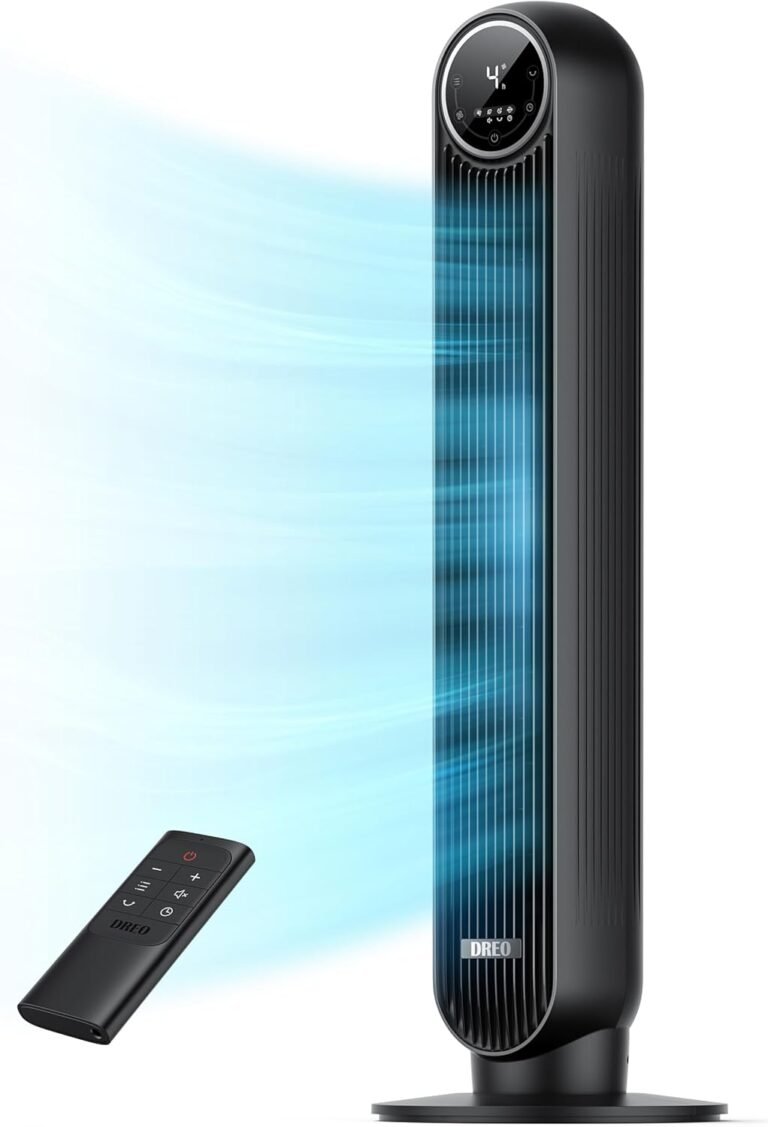
DREO Tower Fan for Bedroom, 28ft/s Velocity, Ultra Quiet Fan, 8 Speeds
The DREO Tower Fan is for cooling and air circulation in bedrooms, living spaces, home offices, and other indoor rooms where you want adjustable airflow without installing a larger cooling system. It is particularly suited to people who want more control over nighttime airflow, including the ability to use a quieter Sleep Mode, adjust the breeze intensity, and distribute air across a wider part of the room through oscillation.
Affiliate link — we may earn a commission, at no extra cost to you.
This DREO tower fan is a slim floor-standing unit, around 36 inches tall, running on a brushless DC motor with eight speeds, four modes including a sleep setting, roughly 90-degree oscillation and a remote so you don’t have to get up. The manufacturer advertises airflow up to 28 ft/s and reach of about 34 feet; I can’t verify those figures independently, and DREO sells several similar-looking towers with different specifications, so check the exact variant’s listed noise level and speed count before buying. What a fan can reasonably do is move air across your skin and stop a room feeling stagnant. What it cannot do is lower the air temperature of the room.
Rung three: an actively cooled topper or pad
These are water-circulating pads with a bedside unit, sometimes with two zones so each side of the bed can be set separately. They are the most expensive option and they add a pump to the bedroom.
They’re worth considering if you’ve worked through the rungs above without success and one of these applies: you sleep on a memory-foam mattress that holds heat and replacing it isn’t realistic; you and a partner need genuinely different temperatures in the same bed; or your bedroom cannot be ventilated or cooled at all. Most people don’t need one. If a lighter duvet and an open window fixed it, you’re done — that’s the article working.
Cooling products I’d be cautious about
Gel pillows, cooling pillowcases and cool-touch fabrics feel genuinely pleasant for the first minute. Then they reach your skin temperature and stay there, because passive materials with little thermal mass have nowhere to send the heat. The sensation is real and brief. If the cool-on-contact feeling helps you settle, fine — just don’t expect it to hold through the night, and don’t buy it as a solution for waking at 3am soaked.
Heatwaves and top-floor bedrooms with no air conditioning
Shut windows, curtains and blinds during the day; open up once outside is cooler than inside. Sleep on the lowest floor you reasonably can. Aim a fan across the room rather than directly at you, and note that public health guidance warns that once air temperature climbs above roughly 35°C, a fan blown straight at the body stops cooling you. A damp flannel on the back of the neck or the wrists helps at the point of getting into bed. Accept that in a genuine heatwave your sleep will be worse, and that this is normal and temporary — expecting otherwise adds pressure you don’t need.
When overheating or night sweats need a clinician, not a shopping list
Bedding cannot fix a medical cause. Drenching night sweats that soak nightwear or sheets, sweats with unexplained weight loss, fever or new lumps, or a sudden change with no change in the room all belong with a GP. So do vasomotor symptoms around perimenopause and menopause, where there are treatment options a mattress pad has no access to. If you snore heavily, gasp or stop breathing in your sleep, or feel sleepy during the day regardless of hours in bed, ask about assessment for sleep apnoea. Sleep problems in children and during pregnancy also belong with a clinician. None of this is a reason to skip the free adjustments — it’s a reason not to buy your way past a symptom.
Common mistakes
Chasing a thermostat number while ignoring the duvet. The room is the outer layer of the system; the duvet is the one touching you.
Changing five things at once. Then you don’t know which one worked, and you’ve spent money you may not have needed to.
Buying the mattress layer before the bedding layer. Cheapest, closest to your skin, easiest to reverse — that’s the order.
Assuming heat is the cause because heat is the symptom. Alcohol in the evening reliably fragments the second half of the night and makes you feel warm and restless doing it. So does a late heavy meal for some people. Worth ruling out before spending.
Letting a tracker score become the point. Watching a number every morning to see whether your new sheets worked is a reliable way to make yourself anxious about sleep, which is its own sleep problem — orthosomnia. The felt sense of the morning is better data than the score.
Conclusion
You are not cooling a room. You’re helping a body shed heat so its core temperature can fall, and the layer closest to your skin has more say in that than the air the thermostat measures. Start there: lighter covers, air moving, a shower earlier, a window open when outside finally cools. If that’s enough, you’ve spent nothing and solved it. If it isn’t, move up one rung at a time and stop as soon as the nights improve. And if you’re waking soaked regardless of what you sleep under, that’s a conversation with a clinician, not a purchase. Either way, you don’t have to sort it out tonight.
Reader questions
Frequently Asked Questions
What is the ideal temperature for sleeping?
Roughly 16–19°C suits most adults, and the widely quoted 18.3°C sits in the middle of that. Treat it as a starting point rather than a target — it’s 65°F converted, not a trial result. If you’re comfortable at 20°C under a light duvet in a room with air moving, you’re fine. The range is genuine, and people differ within it.
Why do I get so hot at night and wake around 3 or 4am?
Waking in the second half of the night is common when heat has been building under the duvet since bedtime — insulation that felt right at 11pm has trapped your own heat and moisture for hours by 3am. It’s also the part of the night most affected by alcohol, which fragments sleep and leaves you warm and restless. If you wake genuinely soaked, repeatedly, and the room isn’t the explanation, that’s worth raising with a GP rather than solving with bedding.
What duvet tog is best for hot sleepers?
Most hot sleepers do well with a summer duvet around 4.5 tog in warm months and staying at or below the 9–10.5 tog all-season range the rest of the year, adding a blanket on the coldest nights. Tog measures insulation only, so a light duvet in a breathable cotton or linen cover will usually feel cooler than a heavier one in a synthetic cover at the same tog.
Do cooling pillows and cooling sheets actually work?
Partly, and briefly. Cool-touch fabrics and gel inserts feel genuinely cool on contact because they conduct heat away from your skin quickly — then they equilibrate with you and the effect fades. Breathable woven sheets like percale or linen do something slightly different and more durable: they let moisture move, which matters more across a whole night. Neither will resolve significant overheating on their own.
My memory foam mattress runs hot. Do I need to replace it?
Not necessarily, and not first. Foam that conforms closely reduces the airflow under you and holds heat, but the layers above it are cheaper to change: a lighter duvet, breathable sheets, and swapping a fully waterproof mattress protector for a breathable one. If you’ve done all of that and still overheat, an actively cooled topper is the reasonable next step — it sits between you and the foam and is far cheaper than a new mattress.
Can my sleep tracker tell me whether a change worked?
It can show you a pattern over weeks, which is useful. It cannot tell you that one warm Tuesday was caused by the room, because consumer devices estimate sleep stages rather than measure them — our piece on whether sleep trackers are accurate goes into what that estimation can and can’t support. Change one thing, give it a couple of weeks, and weigh how your mornings feel at least as heavily as the score.
Sources
- Okamoto-Mizuno K, Mizuno K. Effects of thermal environment on sleep and circadian rhythm. Journal of Physiological Anthropology (2012)
- Haghayegh S et al. Before-bedtime passive body heating by warm shower or bath to improve sleep: a systematic review and meta-analysis. Sleep Medicine Reviews (2019)
- The Best Temperature for Sleep — Sleep Foundation
- Heatwave: how to cope in hot weather — NHS