This is a one-week method for working out why your concentration collapses between 2 and 4pm. It is for knowledge workers and students who have already tried more coffee and want to match the fix to the actual cause.
Introduction
Most advice about the afternoon slump is a list: take a walk, nap, drink water, have another coffee. The trouble is that these work on different mechanisms. A 20-minute nap and a second espresso are not interchangeable. Neither one can do the job of the sleep you didn’t get.
Part of the dip is built in. Timothy Monk’s review of the post-lunch dip describes a dip in alertness and performance in the early afternoon that appears even when people skip lunch. That points to circadian timing rather than food alone. Some afternoon fatigue is normal, then. What varies is how deep the dip goes and what makes it worse: sleep debt, task design, caffeine habits, or the meal itself.
By the end you should be able to put your own dip into one of four patterns, run one intervention for a stated period, and judge honestly whether it worked.
What you’ll need
- A notebook or a notes app. You’ll make one short entry each afternoon for seven days, weekends and days off included.
- A rough record of your sleep: bedtime, wake time, and whether you used an alarm.
- A record of caffeine: what you drank, how much, and the clock time.
- A note of lunch: roughly how large it was and when you ate it.
- Seven ordinary days. A week with travel or deadlines will skew the picture.
You don’t need to buy anything. A wearable sleep tracker is optional, and a written log is enough for this.
Steps
1. Track the afternoon dip for one week
Each afternoon, note when focus dropped, how badly (0 to 3 works fine), and what you were doing at the time. Write down any headache or irritability, and what you ate and drank. It worked if, after seven days, you can see whether the dip follows the clock, the task, the coffee or the plate. If no pattern shows, keep logging for a second week before you choose a branch.
2. If the dip happens every day, including weekends
This points to sleep debt sitting on top of the normal circadian dip. Lim and Dinges’ meta-analysis found that sleep loss hits simple, sustained attention hardest. That is exactly the faculty that fails in a slow afternoon. One caveat: their analysis covered short-term total sleep deprivation, not the chronic mild restriction most people live with, so it supports the direction of the effect and not its size for you.
Intervention: move your bedtime 30 to 60 minutes earlier and hold it for two weeks. Keep wake time fixed. Expected effect: the dip should get shallower. It won’t disappear, because the circadian component stays. It worked if your 0 to 3 ratings fall, especially early in the week.
3. If the dip appears mainly during monotonous or demanding tasks
If weekends and varied days are fine, the cause is probably load and task design, not sleep. In Ariga and Lleras’ lab study, participants on a long, monotonous vigilance task kept their performance up when they briefly switched to a different task partway through. The group that stuck with one task without a break declined. The participants were university students and the task was artificial, so this is a mechanism with modest lab support, not a proven workplace fix.
Intervention: for two weeks, move your most repetitive work out of the 2 to 4pm window. Where you can’t, break it with a deliberate two- to five-minute switch to something different roughly every 45 to 60 minutes. Expected effect: modest. It worked if the task-specific drop-off arrives later or less sharply.
4. If the dip comes with a headache and irritability at the same time each day
Headache, fatigue and irritability are recognised signs of caffeine withdrawal. If they arrive on a schedule, your morning dose is probably wearing off and your body is registering the gap.
Intervention: for ten days, take caffeine at the same times every day, including weekends. Then shrink your largest dose gradually rather than cutting it all at once. Keep any afternoon caffeine well before bedtime; our Sleep & Recovery piece on caffeine cut-off times covers that decision. Expected effect: if withdrawal was the cause, the headache and irritability ease within the first week or so. It worked if they stop clustering at a fixed hour.
5. If the dip follows a large meal
Monk’s work suggests a meal amplifies a dip that is already there; it doesn’t create one. The evidence on which meal composition is best is mixed, and I’d rather say that than give you a macronutrient ratio nobody has shown works.
Intervention: for one week, eat a noticeably smaller lunch, with a snack later if you need one. Expected effect: uncertain, possibly small. It worked if big-lunch days in your log now look worse than small-lunch days.
Common mistakes
Treating a nap as a substitute for sleep. Milner and Cote’s review of napping in healthy adults found that short naps of roughly 10 to 20 minutes tend to improve alertness without much grogginess. Longer naps raise the risk of sleep inertia, the disoriented state Hilditch and McHill review in detail. Inertia is worse when you wake from deep sleep, and that becomes more likely the longer you nap. Keep naps under about 20 minutes. If you need a nap every single day, you have a sleep problem, and a nap won’t fix it.
Expecting a walk to rescue a short night. Berman, Jonides and Kaplan found that a walk in a park improved performance on a directed-attention task more than a walk through city streets. Their samples were small groups of university students. Walks, outdoor light and breaks may help modestly. No break routine can make up for chronic sleep restriction.
Changing everything at once. If you move your bedtime, cut coffee and shrink lunch in the same week, you won’t know which change worked.
Practical tips
Get outdoor light first. If you take a break, take it outside. Daylight is far brighter than indoor lighting, and it comes with the walk.
Fix dim task lighting, without expecting it to cure the dip. A dim desk makes reading harder, which is a comfort problem worth solving on its own terms. No desk lamp has been shown to fix an afternoon dip. If yours is poorly lit, a clamp-mounted option like the one below has a 17-inch light bar and brightness that adjusts from 1% to 100%. Colour temperature runs from 2700K to 6500K, and the clamp fits desks up to 2.36 inches thick.
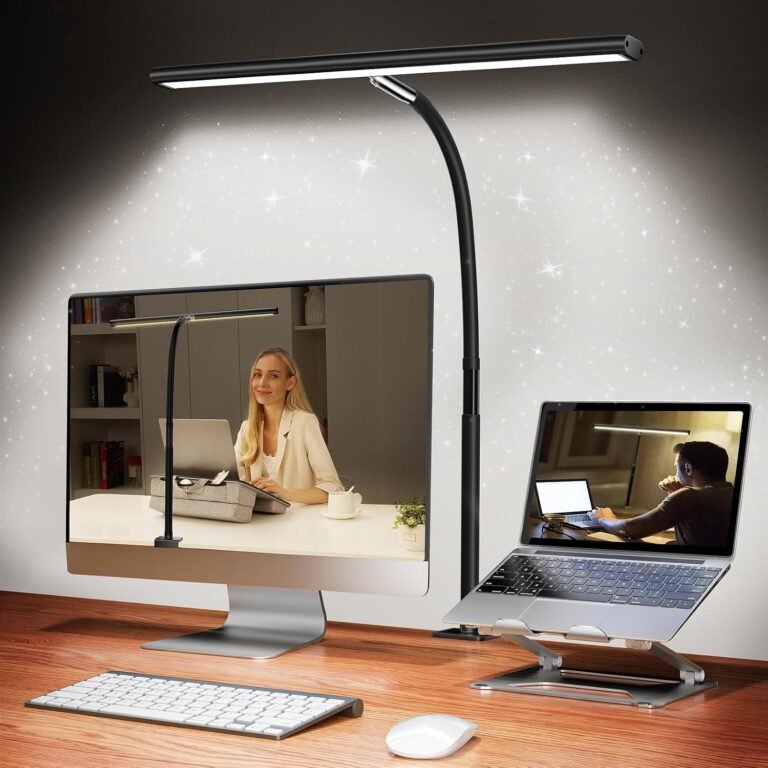
Airlonv
LED Desk Lamp with Clamp, 17 Stepless Dimming Light, Black
This desk lamp is for people who need controlled, adjustable lighting for a desk or work surface. It is suited to reading, studying, writing, crafting, drawing, computer work, and other detailed tasks where the direction, brightness, and color temperature of the light matter.
Affiliate link — we may earn a commission, at no extra cost to you.
Skip what doesn’t work. A second or third coffee late in the day can erode that night’s sleep, which makes tomorrow’s dip deeper. Sugary snacks, energy shots and proprietary "focus" blends that hide their doses haven’t been shown to fix any of the four causes above. If you’re curious about caffeine paired with L-theanine, our separate article covers that combination and what its trials actually measured.
FAQ
Is the afternoon slump normal? A mild early-afternoon dip appears to be part of normal circadian rhythm. Monk’s review describes it occurring even without lunch. A deep, daily collapse is not something to accept as normal.
How long should a nap be? About 10 to 20 minutes, based on Milner and Cote’s review. Longer naps make grogginess on waking more likely.
Will more coffee fix it? Only briefly, and it can backfire. Late caffeine can cut into your sleep, which deepens tomorrow’s dip. If you drink caffeine on an irregular schedule, it can also bring on withdrawal headaches at a predictable hour.
Can a good break routine make up for poor sleep? No. Breaks and walks have modest effects in small studies. Sleep loss impairs the same sustained attention you’re trying to protect.
When should I see a doctor? See a clinician if you nod off without meaning to, feel drowsy while driving, snore heavily or wake gasping, or stay sleepy despite getting enough sleep. These can signal a sleep disorder such as sleep apnea. The same applies if you take prescription medication that affects alertness, have a diagnosed condition, or are asking on behalf of someone under 18. Nothing here is medical advice.
Conclusion
You should now be able to log your dip for a week and identify which of four patterns it follows. Then you can run the single intervention that matches it. If the dip shows up every day, extend your sleep. If it tracks monotonous work, restructure the task. If it arrives with a headache on a schedule, fix your caffeine timing. If it follows big lunches, eat a smaller one. If your log is mixed, start with sleep, since it has the strongest evidence and affects the other three. Give it two weeks before you judge it, and don’t buy anything until you’ve done this.
FAQ
Is the afternoon slump normal?
A mild early-afternoon dip appears to be part of normal circadian rhythm. Monk’s review describes it occurring even without lunch. A deep, daily collapse is not something to accept as normal.
How long should a nap be?
About 10 to 20 minutes, based on Milner and Cote’s review. Longer naps make grogginess on waking more likely.
Will more coffee fix it?
Only briefly, and it can backfire. Late caffeine can cut into your sleep, which deepens tomorrow’s dip. If you drink caffeine on an irregular schedule, it can also bring on withdrawal headaches at a predictable hour.
Can a good break routine make up for poor sleep?
No. Breaks and walks have modest effects in small studies. Sleep loss impairs the same sustained attention you’re trying to protect.
When should I see a doctor?
See a clinician if you nod off without meaning to, feel drowsy while driving, snore heavily or wake gasping, or stay sleepy despite getting enough sleep. These can signal a sleep disorder such as sleep apnea. The same applies if you take prescription medication that affects alertness, have a diagnosed condition, or are asking on behalf of someone under 18. Nothing here is medical advice.