
This is an evidence check for adults taking or considering fish oil or algal oil for focus, memory or "brain health." That includes vegetarians, vegans and people who rarely eat fish, who have a more plausible reason to care about it than most.
The short verdict: most healthy, well-nourished adults should not expect better focus or memory
In cognitively healthy adults who already eat reasonably well, omega-3 supplements have not been shown to improve attention or memory. I hold that conclusion with moderate-to-high confidence. It rests on large, long trials and a Cochrane review, not on a single null result.
A few groups have a better case:
- People who eat little or no oily fish.
- People with a measured low omega-3 index.
- Older adults with mild, self-noticed memory complaints.
Even for them, the evidence is limited to a handful of trials, some of them industry-funded. The doses that were tested sit around 0.7 to 1.2 grams of EPA+DHA per day. Any effect would take three to six months to appear, if it appears at all. A standard 1,000 mg fish oil softgel usually delivers well under that dose.
What we know
EPA and DHA are the long-chain omega-3 fats found mainly in oily fish and in some algae. DHA is a major structural component of brain cell membranes. That fact gets stretched into the popular "your brain is 60% fat" pitch. The fact is accurate, but it describes what the brain is made of. It is not evidence that adding more fat to an adequately supplied brain changes how it performs.
The NIH Office of Dietary Supplements summarises the broader picture this way: research has not consistently shown that omega-3 supplements protect cognitive function in healthy people.
The Cochrane review by Sydenham, Dangour and Lim (2012) looked at cognitively healthy older adults. It found no benefit of omega-3 supplementation for preventing cognitive decline. A later Cochrane review of people who already had mild-to-moderate Alzheimer’s disease also found no convincing benefit.
What the research does support is narrower. Your baseline matters. People who eat little fish have lower blood levels of EPA and DHA, and they are the only group in which a supplement plausibly changes anything.
What the trials actually tested: EPA+DHA dose and study duration
Three trials do most of the work in this debate. The details below cover who was in each one, what dose they took, and for how long.
**OPAL (Dangour et al., American Journal of Clinical Nutrition, 2010).** This trial enrolled 867 cognitively healthy adults aged 70 to 79 in England. They took 200 mg EPA plus 500 mg DHA daily, or an olive-oil placebo, for 24 months. Cognitive scores did not differ between groups. One caveat is worth noting: the placebo group also didn’t decline over two years. That limited the trial’s ability to show protection. Still, it is a large, long, independently run null result in healthy older people.
MIDAS (Yurko-Mauro et al., 2010). This trial enrolled 485 adults aged 55 and over with age-related memory complaints. They took 900 mg of algal DHA daily for 24 weeks. The DHA group made fewer errors on a visual paired-associate learning task, which is a specific episodic-memory measure. Global cognition did not change. The trial was funded by a DHA manufacturer. That doesn’t invalidate it, but it is one positive trial in a specific population, on one outcome.
**Stonehouse et al. (AJCN, 2013).** This trial gave about 1.16 g of DHA daily for six months to healthy adults aged 18 to 45. The researchers reported faster memory reaction times, mainly in women. Effects were stronger in participants with low habitual DHA intake. That is the responder pattern in miniature: whatever signal exists shows up in people who started low.
Taken together, the trials tested roughly 0.7 to 1.2 g of EPA+DHA per day for 6 to 24 months. Where they found anything, it was modest, specific to one or two tests, and concentrated in low-intake or memory-complaint groups. I’d call the healthy-adult case "doesn’t hold up." I’d call the low-baseline case "plausible but unproven."
How long omega-3 could take before an effect appears
Omega-3 does not act like caffeine. EPA and DHA have to be incorporated into cell membranes. Red blood cells live about 120 days, so the omega-3 index (EPA+DHA as a percentage of red blood cell fatty acids) takes roughly three to four months to approach a new steady state. Brain tissue turns over more slowly than blood.
In practice, judging omega-3 after a few weeks tells you nothing. The trials ran six months or longer for a reason.
What remains uncertain
EPA versus DHA. The memory-specific positive trials leaned on DHA. There is no head-to-head evidence in healthy adults showing that one beats the other for focus or memory. Many consumer products are EPA-heavy, which suits cardiovascular dosing more than the memory literature.
Thresholds. No trial has established an omega-3 index level below which cognition reliably improves with supplementation. The commonly cited target of 8% or above comes from cardiovascular research, not cognitive research.
Vegans and vegetarians. Plant-based eaters are an obvious low-baseline group. However, I’m not aware of a well-powered cognitive trial run specifically in them. Their case is inferred from baseline status, not tested directly.
Attention. Most positive findings are on memory tasks. Evidence for sustained attention or "focus" in healthy adults is thin.
Practical implications
Who may have a stronger case for omega-3: people who eat oily fish less than about once a week, vegans and vegetarians, people with a measured low omega-3 index, and older adults with mild memory complaints. If none of those describes you, the honest answer is that a supplement is unlikely to change your focus or memory.
The usual note on fundamentals still applies. If you’re short on sleep, no fish oil will do sleep’s job.
Why typical fish oil capsules may not match trial doses. A standard "1,000 mg fish oil" softgel refers to total oil, not omega-3 content. These products commonly contain around 300 mg of EPA+DHA. Reaching trial doses can take three or four of them a day. Always read the EPA and DHA lines on the label, not the headline milligrams.
Is an omega-3 index test worth the cost? It is worth considering if you’re in a borderline group and want to know whether supplementing even makes sense. A result that is already high is a good reason to save your money. If you do supplement, a retest after four months tells you whether your dose actually moved your levels. For people who eat fish regularly, the test rarely changes the decision.
How to compare fish oil and algal oil products:
- Calculate the cost per gram of EPA+DHA. Divide the bottle price by (servings per bottle × grams of EPA+DHA per serving). Compare that number between products, not the bottle price.
- Match the dose to the trials. Aim for roughly 0.7 to 1 g of EPA+DHA daily. Lean DHA-heavier if memory is your goal.
- Look for independent oxidation and purity testing. Fish oil oxidises, and oxidised oil is the main quality failure in this category. Third-party programmes such as IFOS, USP Verified or NSF test for oxidation markers and contaminants. Brand claims alone are not a substitute.
- Choose algal oil if you’re plant-based. Algal oil is the vegan source of DHA, and some algal products include EPA. Check that the softgel itself isn’t made of gelatin.
If you’ve decided you’re in a plausible-responder group and want a fish-based option, here is one reasonable choice. It supplies 690 mg EPA and 260 mg DHA (950 mg combined) per softgel, from wild Alaska pollock, in triglyceride form. The manufacturer cites IFOS certification records. Two caveats apply: it is EPA-weighted rather than DHA-weighted, and its fish gelatin capsule rules it out for vegetarians and vegans.
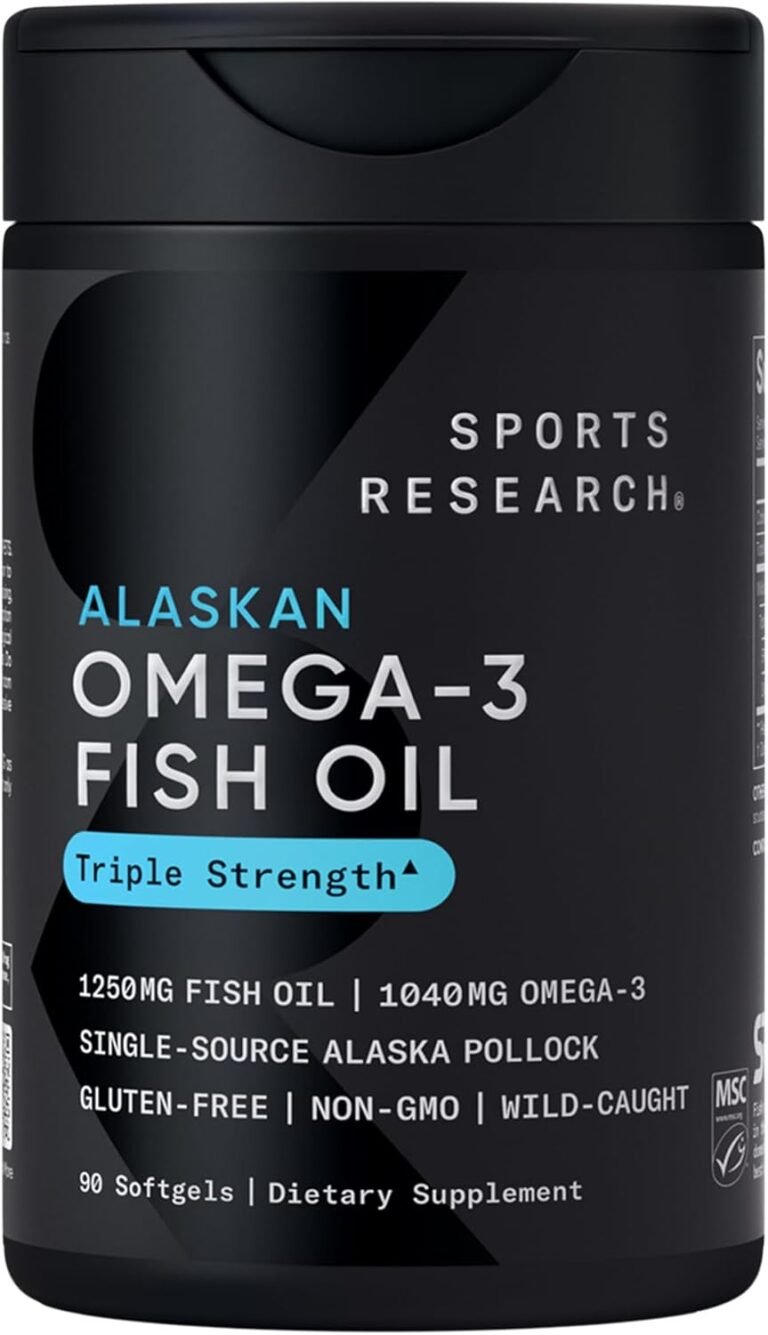
Sports Research
Sports Research® Omega-3 Fish Oil 1250mg from Wild Alaska Pollock, 90 Count
This supplement is for adults looking to add concentrated EPA and DHA omega-3 fatty acids to their daily diet. Sports Research recommends taking one softgel daily with food, or as directed by a qualified healthcare professional.
Affiliate link — we may earn a commission, at no extra cost to you.
If you take anticoagulants or other prescription medication, have a diagnosed condition, or are buying for a minor, check with a clinician first. Nothing here is medical advice.
Limitations
This analysis rests on a small number of trials with different doses, different populations and different cognitive tests, so direct comparisons between them are imperfect. It can’t tell you whether you personally will respond. Nobody can do that in advance, and subjective impressions over months are easily confounded by everything else in your life. I also haven’t covered omega-3 in pregnancy, childhood, depression or diagnosed cognitive impairment. Each of those is a separate evidence base and needs its own clinical conversation.
When buying nothing may be the best choice
If you eat oily fish regularly and have no memory concerns, skip it. The evidence does not support omega-3 for focus or memory in you. Choosing not to buy is the evidence-based choice here, not a compromise.
If you rarely eat fish, are plant-based, have a low measured omega-3 index, or are an older adult with mild memory complaints, a trial-level dose is a reasonable, low-risk experiment. That means about 0.7 to 1 g of EPA+DHA daily, from a third-party-tested product, for at least four to six months. Treat it as an experiment with modest expected returns, not a fix.
Reader questions
Frequently Asked Questions
Short answers to the questions that come up most.
How much omega-3 should I take for memory?
The trials that tested memory used roughly 0.7 to 1.2 grams of combined EPA and DHA per day. Count EPA plus DHA from the label, not total fish oil. Supplemental intakes up to 5 g/day of EPA+DHA are generally considered safe for adults, but higher doses are not better for cognition, and anyone on blood thinners should ask a clinician.
How long does fish oil take to work for the brain?
If it does anything for you, expect a timescale of months. Blood omega-3 levels take about three to four months to plateau, and the cognitive trials ran from six months to two years.
Is EPA or DHA better for memory?
The memory-specific positive trials mostly used DHA, so DHA has the stronger circumstantial case. No good head-to-head trial in healthy adults has settled the question.
Is algal oil as good as fish oil?
For DHA, algal oil is a direct source rather than a substitute. It’s where fish get their omega-3s in the first place, and the MIDAS trial used algal DHA. Check the EPA content separately if you want both.
Should I get an omega-3 index test?
It’s most useful if you eat little fish and want to know whether supplementing is worth it. It’s also useful as a retest after four months to confirm your dose is working. Regular fish eaters can usually skip it.
Sources
- Dangour AD et al. Effect of 2-y n-3 long-chain polyunsaturated fatty acid supplementation on cognitive function in older people (OPAL). American Journal of Clinical Nutrition, 2010
- Yurko-Mauro K et al. Beneficial effects of docosahexaenoic acid on cognition in age-related cognitive decline (MIDAS). Alzheimer’s & Dementia, 2010
- Stonehouse W et al. DHA supplementation improved both memory and reaction time in healthy young adults. American Journal of Clinical Nutrition, 2013
- Sydenham E, Dangour AD, Lim WS. Omega 3 fatty acid for the prevention of cognitive decline and dementia. Cochrane Database of Systematic Reviews, 2012
- NIH Office of Dietary Supplements: Omega-3 Fatty Acids Fact Sheet for Health Professionals