This is a dosing and expectations piece on caffeine plus L-theanine, written for people who already drink coffee, dislike the jittery edge of it, and are considering their first deliberate supplement purchase rather than a full stack.
Executive summary
The combination has been tested in humans, which already puts it ahead of most things sold for focus. What those tests showed was modest: small, short-lived improvements on attention-switching and distraction tasks, measured in the first couple of hours after a single dose, mostly in healthy young adults. Almost all of the measurable cognitive lift appears to come from the caffeine. L-theanine on its own does very little for performance.
The most defensible reason to add theanine is not extra cognition — it is that it appears to blunt some of caffeine’s less pleasant subjective effects. That is a real benefit if jitteriness is your actual complaint. It is also a smaller intervention than simply drinking less coffee.
The commonly quoted 1:2 caffeine-to-theanine ratio is not an established optimum. It is the ratio that happened to be used in one influential study. And nobody has properly tested what four weeks of daily use does, which is the question most buyers actually have.
What we know
Caffeine is the best-evidenced cognitive drug most people will ever take, and its profile is well characterised: it reliably improves alertness, simple reaction time and vigilance, with the largest effects in people who are tired, sleep-restricted or abstaining from their usual intake. It also produces dose-dependent side effects — jitteriness, elevated heart rate, anxiety in susceptible people, and sleep disruption when taken too late in the day.
L-theanine is an amino acid found in tea leaves. It crosses into the brain and, in resting EEG studies, has been associated with modest increases in alpha-band activity — a pattern loosely associated with relaxed wakefulness. It is not a stimulant and it is not sedating at typical doses.
The pairing is usually justified by the observation that tea contains both, and that tea drinkers describe a steadier kind of alertness than coffee drinkers do. That is a reasonable hypothesis to test, and it has been tested — a handful of times, acutely, in small samples. The evidence base for the combination is three or four well-known trials and one systematic review, not a literature.
The 2014 systematic review and meta-analysis by Camfield and colleagues in Nutrition Reviews remains the standard summary of the acute data.
What the evidence says
Haskell and colleagues (2008), published in Biological Psychology, tested 50 mg of caffeine and 250 mg of L-theanine, alone and in combination, against placebo in healthy adults using a within-subjects design. Caffeine alone improved reaction time, subjective alertness and some working memory measures. L-theanine alone did not improve performance — on some measures it slowed responses slightly. The combination improved speed and accuracy on an attention-switching task and reduced susceptibility to distracting information, relative to placebo.
Owen and colleagues (2008), in Nutritional Neuroscience, used 50 mg of caffeine with 100 mg of L-theanine in healthy young adults. The combination again improved attention-switching accuracy, reduced susceptibility to distraction, and improved self-reported alertness and tiredness, with faster performance on a visual information processing task. This is the study that gave the internet its 1:2 ratio.
Camfield and colleagues (2014) pooled the acute tea-constituent studies and concluded that the combination produces small benefits to attention within roughly the first two hours after dosing, with caffeine accounting for most of the effect and L-theanine contributing little to performance on its own.
Three things about the shape of this evidence matter more than the headline. First, the populations: healthy young adults, typically light caffeine consumers or asked to abstain overnight — not someone four cups deep on a Wednesday afternoon. Second, every one of these is a single dose measured over hours. Third, memory and higher-order reasoning were largely unaffected. What improved was the ability to hold attention on a task and resist irrelevant information for a short window. That is a genuine finding. It is also a narrow one.
What remains uncertain
Whether there is an optimal ratio at all. The 1:2 and 1:5 figures circulating online are artefacts of which doses got tested, not the output of a dose-response study. I am not aware of a trial that compared several ratios head to head in healthy adults, which means anyone stating a ratio as fact is over-reading the literature.
What happens with repeated use. Tolerance to caffeine’s subjective alertness effects develops within days. Whether theanine’s side-effect-blunting persists alongside that, or fades, has not been established. A small four-week trial of L-theanine alone (Hidese and colleagues, 2019) reported improvements in stress and sleep measures in a modest sample — but that is theanine by itself, in people with stress complaints, not the combination in healthy workers.
Whether theanine does anything for people already carrying a substantial daily caffeine tolerance. The trials did not recruit them.
Mechanism
Caffeine’s mechanism is settled: it blocks adenosine receptors, which removes part of the brake that accumulating sleep pressure puts on arousal. It doesn’t create capacity; it masks fatigue.
L-theanine is structurally similar to glutamate and appears to modulate glutamatergic and GABAergic signalling, which is the usual explanation offered for the alpha-EEG findings. Mechanistically, a compound that nudges cortical activity toward relaxed wakefulness sitting alongside a stimulant is a coherent idea — and the alpha data are real.
The jump that marketing makes quietly is from "shifts an EEG measure" to "you will think better on Tuesday." Those are different claims, and only the first is well supported.
Practical implications
If you want to try it, start small. 100 mg of caffeine — roughly a single modest coffee, or half a standard caffeine tablet — with 100 to 200 mg of L-theanine is defensible, sits within the range the trials used, and is easy to adjust. There is no evidence that going higher on theanine buys more cognition.
Buy the two ingredients separately, in labelled doses. The whole point of this combination is that you can quantify it. Proprietary blends that list a total milligram figure for a mixture, or pre-mixed focus drinks that don’t print the caffeine and theanine amounts separately, make that impossible. Check the label: if a drink gives you 160 mg of caffeine and 100 mg of theanine, you should know that’s more caffeine than any of the trials used.
For the theanine side, a single-ingredient capsule at a stated dose is the sensible format.
Nutricost
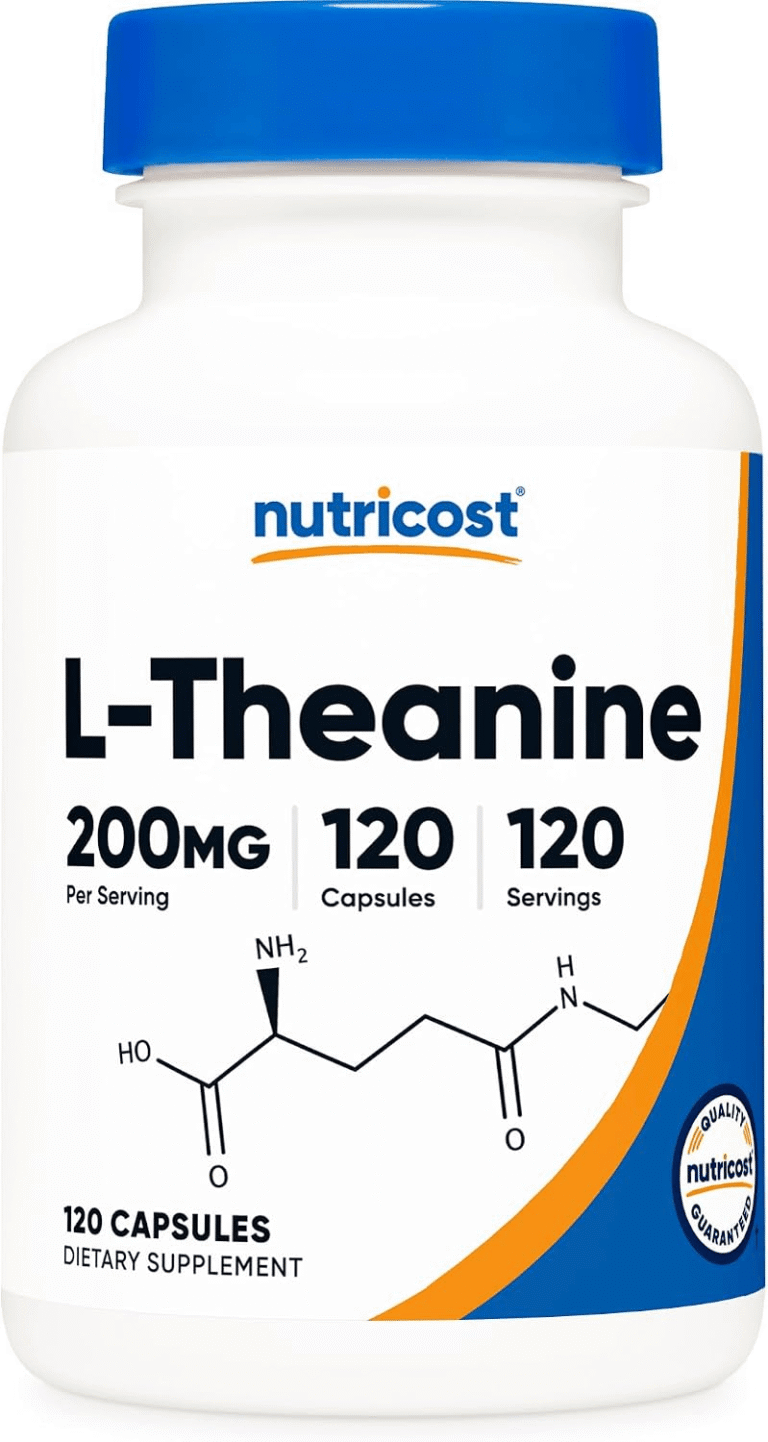
Nutricost L-Theanine 200mg, 120 Capsules, Double Strength, Gluten Free
Nutricost L-Theanine is for adults looking to add a measured amount of L-theanine to their routine, particularly when the goal is relaxation or a calmer form of focus. It can also be relevant to people experimenting with the combination of L-theanine and caffeine, which is commonly used as a way of pursuing alertness without making the experience entirely about stimulation. The evidence for specific cognitive benefits should be considered separately from the manufacturer’s marketing claims.
Affiliate link — we may earn a commission, at no extra cost to you.
Nutricost lists 200 mg per capsule, 120 capsules per bottle, single active ingredient, and says the product is third-party tested and made in a GMP-compliant facility — claims I can report but not verify. At 200 mg per capsule you can’t easily take 100 mg, which is worth knowing before you buy.
Timing. Take it before the work, not during it: the measured effects landed inside the first two hours. For sleep, caffeine’s half-life is roughly five hours in most adults, and a small controlled study by Drake and colleagues found that 400 mg taken six hours before bed still measurably disturbed sleep. An eight-hour cut-off before your intended bedtime is a reasonable default, earlier if you’re sensitive.
If you’re already a heavy coffee drinker, be honest about the intervention you’re choosing. Adding theanine to an established tolerance is the smaller, less studied move. Cutting your caffeine dose — or moving it earlier — is the bigger lever, and if your afternoons are rough because your sleep is short, no capsule outperforms fixing that.
None of this is medical advice. Anyone with an anxiety disorder, a heart condition, high blood pressure, a pregnancy, a prescription that interacts with stimulants, or a child in the equation should be talking to a clinician, not to me.
Limitations
This analysis rests on a small number of acute, single-dose trials in healthy young adults, several conducted with industry involvement, using cognitive batteries that detect narrow effects. It cannot tell you what the combination does after four weeks of daily use, whether it helps a habituated heavy caffeine consumer, or what the right ratio is for you. It also can’t separate genuine pharmacology from expectancy — you will know when you’ve taken something, and that matters more for a subjective outcome like "calm" than for reaction time.
Conclusion
Caffeine plus L-theanine holds up as a modest, cheap, low-risk tweak — and it does not hold up as a cognitive enhancer. The realistic benefit is that adding theanine may take some of the edge off your caffeine, which is worth something if the edge is your problem. The cognition is coming from the caffeine, and the best-evidenced way to improve the caffeine experience is still to take less of it, earlier in the day. Try it if you’re curious; expect a smoother cup, not a better brain.
Reader questions
Frequently Asked Questions
What is the best caffeine to L-theanine ratio?
The honest answer is that nobody has established one. The 1:2 figure comes from Owen and colleagues (2008), who used 50 mg of caffeine with 100 mg of theanine; Haskell and colleagues used 50 mg with 250 mg, which is 1:5. Both found effects. No trial I’m aware of compared ratios head to head in healthy adults, so treat any confidently stated ratio as a convention rather than a finding.
Does L-theanine actually stop caffeine jitters?
Partly, and this is probably the combination’s strongest real-world selling point. In the acute trials, adding theanine shifted subjective measures — alertness and tiredness ratings improved, and the unpleasant edge appeared somewhat blunted. What hasn’t been shown is that it eliminates anxiety or palpitations at high caffeine doses. If 300 mg of caffeine makes you anxious, 200 mg of theanine is a smaller fix than 150 mg of caffeine.
Can I take it every day, and does it stop working?
It’s not established either way. Tolerance to caffeine’s felt alertness effects develops within days of regular use, so the stimulant half of the combination almost certainly delivers less over time. Whether theanine’s contribution persists hasn’t been studied in the combination beyond single doses. A small four-week trial of theanine alone reported some benefit on stress and sleep measures, but that’s a different question in a different population.
Does L-theanine on its own do anything for focus?
Very little, based on the performance data. In Haskell’s trial, theanine alone failed to improve cognitive measures and slowed responses on some of them; the Camfield review reached a similar conclusion. Its more interesting solo evidence concerns relaxation and sleep, not attention. If you want focus from this pair, the caffeine is doing the work.
Are pre-mixed focus drinks sensibly dosed?
Some are; many hide the answer. The two things to check on the label are the caffeine figure and the theanine figure, stated separately in milligrams. If a product only gives a total for a proprietary blend, you cannot evaluate it, and I would not buy it. If the caffeine number is 150 mg or higher, note that it exceeds what the combination trials used — which doesn’t make it unsafe, but it does mean you’re not replicating the studies.
How late in the day can I take it?
Judge by the caffeine, not the theanine. With a half-life of around five hours in most adults, and a small controlled study by Drake and colleagues finding that 400 mg six hours before bed still disrupted sleep, an eight-hour gap before your intended bedtime is a sensible default. If you’re sensitive or your sleep is already fragile, make it earlier.
Sources
- Haskell CF et al. (2008), ‘The effects of L-theanine, caffeine and their combination on cognition and mood’, Biological Psychology
- Owen GN et al. (2008), ‘The combined effects of L-theanine and caffeine on cognitive performance and mood’, Nutritional Neuroscience
- Camfield DA et al. (2014), ‘Acute effects of tea constituents L-theanine, caffeine, and epigallocatechin gallate on cognitive function and mood: a systematic review and meta-analysis’, Nutrition Reviews
- Drake C et al. (2013), ‘Caffeine effects on sleep taken 0, 3, or 6 hours before going to bed’, Journal of Clinical Sleep Medicine
- Hidese S et al. (2019), ‘Effects of L-Theanine Administration on Stress-Related Symptoms and Cognitive Functions in Healthy Adults: A Randomized Controlled Trial’