For anyone eyeing a two-week CGM programme — Lingo, Stelo, Ultrahuman, a Zoe or Levels-style subscription — because they want fuelling insight, reassurance about a family history, or just to know whether the number means anything before they spend. This is what the sensor measures, how precisely, and what that precision allows you to conclude.
Executive summary
A consumer CGM measures one thing: an electrical current generated by an enzyme reaction with glucose in the fluid between your skin cells. Everything else — the smooth curve, the spike score, the "metabolic age" style composite — is derived from that current by algorithm.
The measurement is good enough to see the shape of your day. It is not good enough to adjudicate between two similar meals on a single trial, and it is not a screening test. Of the three jobs people buy one for, I’d call it adequate for detecting large, repeatable differences in how you respond to food, marginal for endurance fuelling, and inadequate for deciding whether you have prediabetes. Confidence in that ordering: reasonably high. Confidence in any specific accuracy figure for a specific consumer sensor: low, because most published validation was done in people with diabetes.
What we know
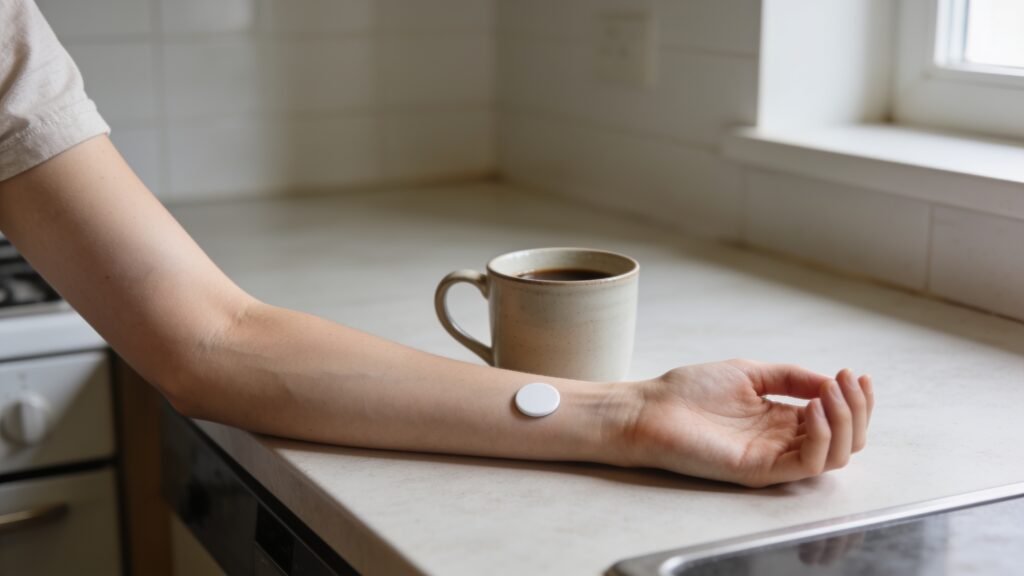
The filament under your skin does not sit in a blood vessel. It sits in interstitial fluid, and it doesn’t detect glucose directly — it detects the current produced when glucose reacts with an immobilised enzyme, usually glucose oxidase, on a working electrode. Current in, glucose concentration out, via a factory calibration curve. Interstitial glucose is measured. Blood glucose is estimated from it.
That distinction is not pedantry. It sets a floor on what the device can resolve, and no amount of app polish raises that floor.
The regulatory position is equally clear. The US Food and Drug Administration cleared the first over-the-counter CGM for people not using insulin in 2024, and the clearances are for wellness and pattern-spotting, not diagnosis. Abbott states that Lingo is for adults 18 and over who are not taking insulin and is not intended to diagnose or manage disease. Diagnosis of prediabetes and type 2 diabetes still runs on HbA1c, fasting plasma glucose or an oral glucose tolerance test, on the thresholds set out in the American Diabetes Association’s Standards of Care. A CGM trace is not on that list, and the thresholds were never derived from one.
What the evidence says
Accuracy is reported as MARD — mean absolute relative difference against a laboratory reference. Current-generation sensors are generally reported in the high single digits to low double digits as a percentage. Three things about that number matter more than its size.
It is a population average across a whole wear period. It says nothing about the error on any single reading. It is mostly generated in people with diabetes, whose glucose ranges far wider than yours — a sensor that tracks a swing from 4 to 18 mmol/L (70 to 320 mg/dL) creditably is being graded on a task that has little to do with resolving 5.6 from 6.3. And accuracy is not uniform across wear: the first day after insertion is consistently the weakest, which is why sensors have a warm-up period at all.
Then the lag. Interstitial glucose trails blood glucose because the molecule has to physically leave the capillary. Published estimates of the total delay — diffusion plus the algorithmic smoothing applied on top — cluster in the region of five to fifteen minutes, and the gap widens when glucose is moving fast. Sharp rise, and the screen under-reads. Sharp fall, and it over-reads. Your peak is not where the app draws it.
Sensor-to-sensor disagreement is the finding nobody prints on the box. Wear two at once and the curves rhyme without matching. I’ve done this and the peaks didn’t line up, in time or in height. Do the arithmetic: a 9% typical error at 6.7 mmol/L (120 mg/dL) is roughly 0.6 mmol/L (11 mg/dL) per sensor, and two independent errors can point in opposite directions. Call the honest resolution limit somewhere near 1 mmol/L (roughly 18 mg/dL) on a single-trial peak comparison.
And the biology is noisy before the sensor gets involved. Zoe’s own PREDICT work in Nature Medicine found large differences between people in postprandial response — and meaningful variation within the same person eating the same meal on different days. Sleep, prior exercise and stress all move it.
What remains uncertain
Whether postprandial spikes in a metabolically healthy person predict anything about their future is genuinely unsettled. The thresholds people quote at each other online — stay under 7.8 mmol/L, flatten the curve — are borrowed from diagnostic criteria for glucose tolerance testing, not from outcome data on CGM curves in non-diabetics.
More importantly, nobody has shown that a fortnight of this data improves a health outcome. Plenty of people change what they eat after wearing one. Whether they’d have changed as much from a single HbA1c and a conversation is untested.
Unlike wrist optical sensors, skin tone isn’t a signal-chain problem here — the measurement is electrochemical, not optical. But validation populations still skew, and accuracy in lean, athletic, non-diabetic wearers during exercise is thinly characterised.
Mechanism
The full chain, in order: glucose diffuses from capillary into interstitial fluid; it reacts at the enzyme-coated filament; electrons move to the electrode; the transmitter reads a current in nanoamps; a factory calibration converts current to concentration; a filter smooths the sample stream; the app interpolates a continuous line and, depending on the product, wraps it in a proprietary score.
Every step after the electrode is inference. The score you’re being sold is four layers of processing away from the only thing that was measured.
This also explains the failure modes. Compression lows happen when you lie on the sensor and locally restrict perfusion — the reading dives, then recovers when you roll over. It looks exactly like a nocturnal hypo and it isn’t one, which is worth knowing if you’re also trying to read your sleep data. Warm-up drift happens because the tissue around a freshly inserted filament is still settling. Sensor variation happens because each filament is a hand-built-ish electrochemical cell trusting a factory curve.
Practical implications
Apply the roughly 1 mmol/L (about 18 mg/dL) resolution limit to the three things people actually buy these for.
Comparing two meals: adequate, but only for big differences, repeated. White rice versus lentils, eaten three times each, will separate cleanly. Oats with berries versus oats with banana, once each, will not — that difference lives inside the noise. If you’re going to do this, repeat every comparison and ignore anything under about 1 mmol/L.
Endurance fuelling: marginal. The lag is worst exactly when you need it — during a hard effort, when glucose is moving fastest. Add motion artefacts and arm compression. Worse, the decision rarely changes: you take carbohydrate on a clock in long efforts regardless of what the screen says. Where I did find it useful was unglamorous — rehearsing race-morning breakfast timing in training and seeing whether I started long sessions already drifting down. That changed my pre-session timing. It did not change my in-session plan.
Screening yourself for prediabetes: inadequate. Not because the sensor is bad, but because it isn’t the test. Use it as a prompt, not a verdict: persistently high morning readings are a reason to book an HbA1c, nothing more.
If you want a fortnight of pattern-spotting, Abbott’s two-sensor Lingo pack is the straightforward version of the trade — each sensor runs up to 14 days, no charging, water-resistant to 1 m for 30 minutes per Abbott’s product information. The limitation I’d flag from wearing one: there is no way to check a suspicious reading against anything, and the app nudges you toward its own composite score rather than the raw trace.
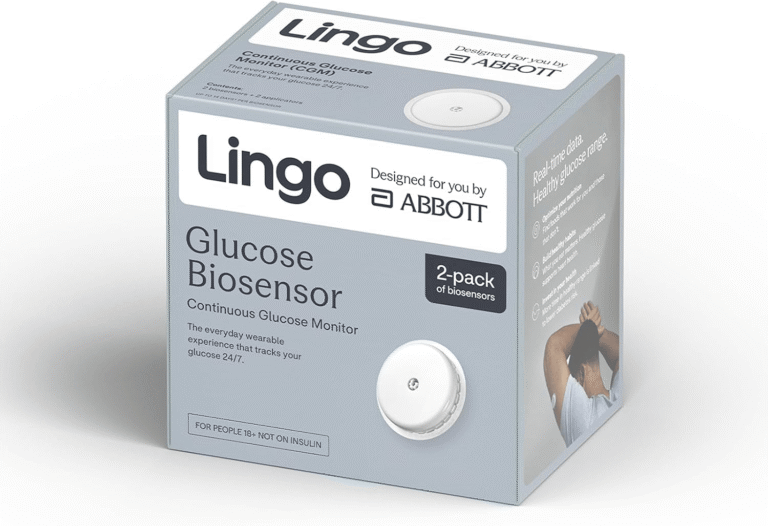
Abbott.
Lingo Continuous Glucose Monitor (CGM) 2-Pack. 24/7 Glucose Tracking
The Lingo CGM is for adults who want to learn more about their individual glucose patterns and how everyday choices such as meals and exercise affect them. It is particularly suited to people experimenting with nutrition, exercise routines, and healthier habits who want continuous data rather than occasional measurements. It is not intended as a replacement for medical glucose monitoring or diabetes management. Abbott specifically limits its intended users to adults 18+ who are not taking insulin.
Affiliate link — we may earn a commission, at no extra cost to you.
The consumable maths is the product. There is no owning these outright. The hardware expires on a 14-day clock, whether that’s sold as packs (Lingo, Stelo) or bundled into a coaching subscription (Ultrahuman M1, Levels, Zoe). Before you buy, check three things on the current product pages: wear time per sensor, whether the app still shows your history when you stop paying, and whether you can export a CSV. Pattern libraries built inside a subscription app are the part that quietly disappears.
Limitations
I have not worn every product named here, and I have run no controlled comparison between them. The accuracy figures in circulation come from manufacturer-sponsored validation, mostly in people with diabetes; I am reasoning from those to a population they weren’t measured in, which is a real extrapolation. My resolution estimate is back-of-envelope arithmetic from a typical MARD, not a measured repeatability figure for any named sensor. Prices, subscription terms and wear times change and are not stated here for that reason — check them yourself at purchase. And nothing in this piece establishes whether spike-flattening does you any good.
Conclusion
Buy one if you’re metabolically curious, accept it as a coarse instrument, and plan to learn three or four large things about your own habits in a fortnight. Skip it if you’re an endurance athlete hoping for in-race fuelling precision — the lag is in the wrong place for that, and a fuelling clock costs nothing. Skip it entirely if what you actually want is reassurance about a family history of type 2 diabetes. That’s a GP appointment and an HbA1c, and the sensor cannot do it.
A device flagging something odd is a reason to see a doctor. It is never a diagnosis. Do not self-diagnose from a CGM curve.
Reader questions
Frequently Asked Questions
Common questions about consumer CGM accuracy, lag, subscriptions and what the readings can and cannot tell you.
Are CGMs accurate for non-diabetics?
Accurate enough to show the shape of your day, not accurate enough to separate two similar meals. The published accuracy figures were largely generated in people with diabetes, across a much wider glucose range than yours. In the narrow band a healthy person lives in, the sensor’s error and the day-to-day variation in your own biology are both comparable to the differences you’re trying to detect.
How far behind blood glucose is the reading on screen?
Estimates of the combined physiological and algorithmic delay generally land in the region of five to fifteen minutes, and it widens when glucose is changing quickly. Practically: during a fast rise the screen under-reads, during a fast fall it over-reads, and the true peak happened earlier and was probably a little higher than the curve shows.
Is every post-meal spike a problem?
No. A rise after eating carbohydrate is normal physiology — that’s what insulin is for. The thresholds people trade online are borrowed from diagnostic glucose tolerance testing, not from outcome evidence on CGM curves in people without diabetes. Zoe’s own PREDICT research found large variation between people, and real variation within the same person eating the same meal on different days.
What happens to my data when the subscription lapses?
It depends on the product, and it’s the thing to check before paying. The sensor itself expires on its own clock regardless. What varies is whether the app keeps showing your history, whether coaching and scores vanish, and whether you can export raw readings as a file. If export isn’t offered, treat the insight as rented.
Should I get a finger-prick meter as well?
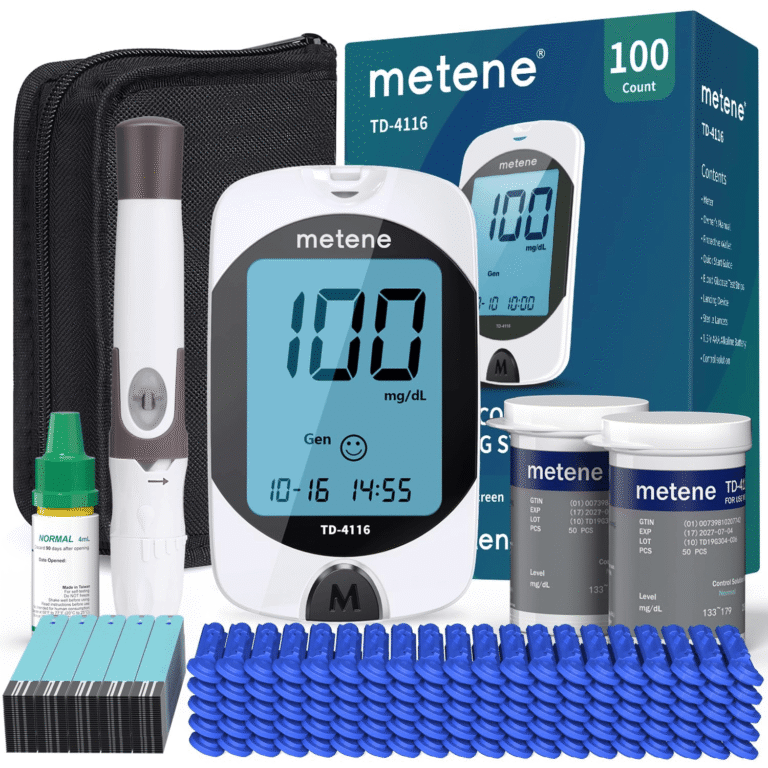
It’s a reasonable sanity check if a CGM reading looks implausible — a suspected overnight compression low, for instance. A kit like the Metene TD-4116 bundles the meter with 100 strips, 100 lancets and control solution, and stores readings with rolling averages. Two honest limitations: it’s one moment in time rather than a trend, and the manufacturer’s documentation frames it as a device for diabetes monitoring, not a wellness gadget.
Metene
Metene TD-4116 Blood Glucose Monitor Kits, Blood Sugar Testing Kit, HSA/FSA
The Metene TD-4116 is for routine at-home blood glucose testing using a small blood sample obtained with the included lancing device. It is suited to people who need to monitor their glucose regularly and want the meter, test strips, lancets, and basic testing accessories packaged together. The 100-strip supply also makes it more appropriate for ongoing monitoring than for someone who only wants to take occasional measurements.
Affiliate link — we may earn a commission, at no extra cost to you.
Sources
- FDA clears first over-the-counter continuous glucose monitor (US Food and Drug Administration)
- American Diabetes Association, Standards of Care in Diabetes — diagnosis and classification
- Berry et al., Human postprandial responses to food and potential for precision nutrition (PREDICT 1), Nature Medicine, 2020
- ISO 15197:2013 — In vitro diagnostic test systems: requirements for blood-glucose monitoring systems
- Abbott Lingo — product and support information
- Dexcom Stelo — product information
- Ultrahuman M1 — product information
- Zoe — programme and research information