Set a motorised wall unit to 100 lb, then load a barbell to 100 lb, and the two lifts won’t feel the same. This piece explains why.
It is for three groups of people:
- Anyone weighing a $2,000–$4,000 connected strength machine against free weights.
- Anyone looking at a used unit.
- Owners whose machine numbers don’t match their barbell numbers.
Executive summary
Tonal-style machines make resistance with a motor. The weight on screen is the cable tension the system is set to produce, not a mass being pulled by gravity.
Tempo and Peloton Guide-type systems generate no resistance at all. You lift real weights, and a camera estimates your reps and form.
That means everything beyond raw resistance is derived: rep counts, estimated one-rep max (e1RM) and strength scores.
My confidence is high on the mechanical differences, because they follow from basic physics. It is low on accuracy figures. I could not find independent, published validation of these devices’ weight output or rep counting that I’d stand behind.
The verdict follows from the measurement:
- Connected machines suit beginners who are short on space, can’t make noise, need coaching and will pay a membership indefinitely.
- A rack is the better buy for anyone who wants to get strong under a barbell.
What a connected strength machine is actually measuring
Start with what each system physically does. The three types are very different machines.
Tonal is a wall-mounted unit with two adjustable arms. The resistance comes from a motor rather than plates. Tonal’s marketing lists:
- a maximum digital weight of up to 200 lb
- modes that change resistance during a rep, including eccentric, chains and spotter
The motor is both the weight and the measuring instrument.
Tempo builds its systems around real plates and dumbbells. A depth-sensing camera watches you lift and turns what it sees into rep counts and form cues. The load is real. The camera does not measure force. It estimates movement.
Peloton Guide is a camera that connects to your TV. You supply your own dumbbells. It uses computer vision to track movement, so the resistance is yours and the tracking is inferred.
All three are sold around a membership, and Tonal leans on it most heavily. Membership pricing and what it unlocks have changed over time. Check current terms at the point of purchase rather than trusting any review, including this one.
Why motor resistance is not the same as a barbell
Measured versus derived on Tonal
A motor-driven system knows two things directly:
- how far the cable has travelled
- what output it is commanding
From those it reports weight, reps, range and power. Rep counting from cable travel should be fairly robust, because it tracks the physical cable rather than a picture of you.
The displayed weight is a control target. How closely the delivered tension tracks that target at every speed of the rep isn’t something I can find independently verified.
Gravity versus a motor
A barbell’s weight always pulls straight down. Its mass also has inertia. Driving it fast out of the bottom of a squat takes more force than its weight, and stopping it takes force too. A motor can hold tension steady regardless of how fast you move, or vary it on purpose. The same nominal number can therefore be a different stimulus.
Three more differences matter:
- Line of pull. On a cable unit, the force follows the cable from the arm’s position, not straight toward the floor.
- Balance. Two independent handles demand different stabilisation from a fixed bar.
- Leg loading. Nothing loads your spine and legs the way a back squat does.
Modes make the number less meaningful
The special modes muddy the logged weight further:
- Eccentric mode adds load on the way down.
- Chains mode increases load through the rep.
- Spotter mode reduces load when you slow.
A spotter-assisted set at a given weight is not comparable to an unassisted one, even though the log may show the same weight.
Camera rep counting
Pose estimation infers joint positions from images. It degrades in predictable conditions:
- dumbbells or limbs blocking key joints
- poor lighting
- baggy clothing
- being partly out of frame or at an awkward angle to the camera
- very fast tempo
- partial-range reps
- a second person or a pet in view
These failure modes are inherent to the method. Their size for any specific product is not something I can quantify.
e1RM and strength scores
An e1RM is a formula applied to load and reps. Epley and Brzycki are common examples. These formulas are known to lose accuracy as rep counts rise.
Whatever weight goes into the formula carries every caveat above. Strength scores are proprietary composites built on top of that. Treat them as a trend line for that specific machine, not a measurement of your strength.
What remains uncertain
Several things I could not resolve from public evidence:
- How closely delivered motor tension matches the displayed number across fast concentrics, slow eccentrics and changes of direction.
- Camera rep-count error rates broken down by exercise, body type, clothing or lighting.
- How strength scores are calculated or weighted.
- How large the machine-to-barbell gap is for a given lifter. It likely differs by movement, training history and how much stabilisation each lift demands, and it can run in either direction.
- Long-term reliability, and how long manufacturers will support older hardware and software.
Three-year cost and who should buy what
Run the real number before buying
Three-year cost is hardware, plus 36 months of membership, plus accessories and installation. Every $10 of monthly fee adds $360 over three years.
For the free-weight side, price the specific rack, barbell, plates, bench and adjustable dumbbells you would actually buy. That is a one-time cost, and that equipment holds resale value well.
Buying used
Before you pay, ask the manufacturer directly:
- Does the membership transfer to a new owner?
- Is there an activation fee?
- What works with no membership at all?
Our earlier piece on wearable subscriptions covers what stops working when you cancel. With equipment, the stakes are higher.
What you lose if you cancel
This is where the systems split:
- Tempo and Peloton Guide: you keep the physical weights whatever happens to the software.
- Tonal: the motor is the weight. If the software gates its functions, the resistance itself is at stake. Confirm current policy in writing.
Who each option suits
Buy a connected machine if all of these apply:
- You’re short on space.
- You can’t drop plates in an apartment.
- You’re new to lifting.
- You honestly won’t train without a coach telling you what to do.
Buy a rack, a barbell and adjustable dumbbells if you want to squat and deadlift heavy, and want numbers that mean something in any gym.
The middle option
If you want machine-style training without an app, a selectorised stack machine uses real gravitational load. Marcy’s MWM-988 has a 150 lb stack and stations for:
- presses and flyes
- lat pulldowns
- low-cable work
- leg extensions
- preacher curls
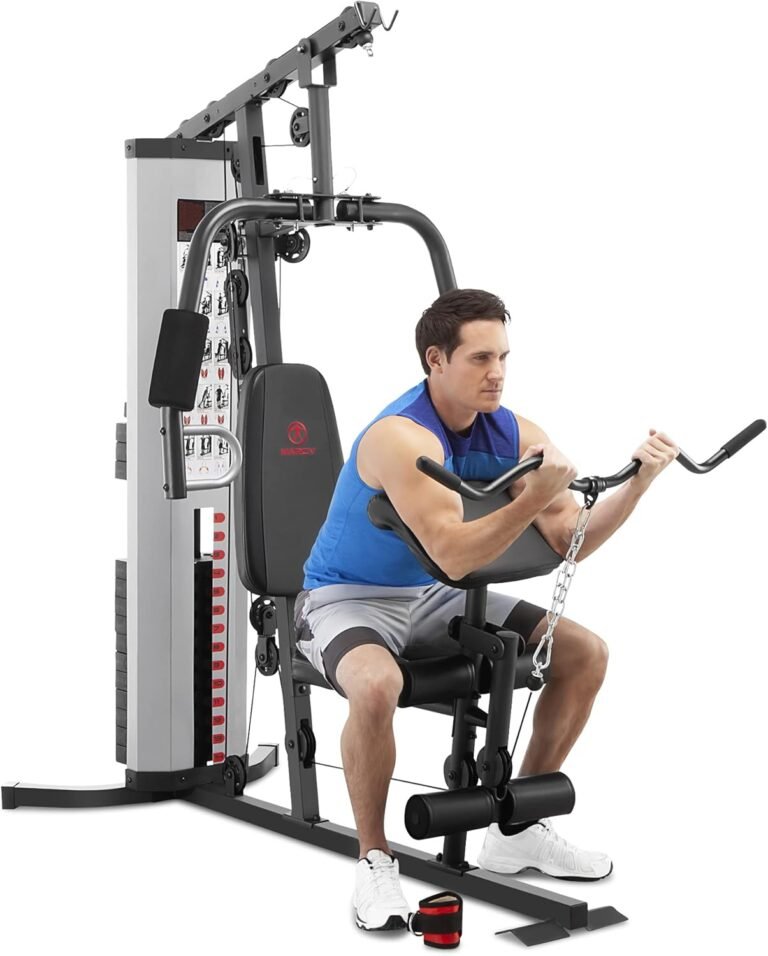
Marcy
Marcy Multifunction Home Gym Workout Station, 100 to 200 lb Weight Stack
The Marcy MWM-988 is for people who want a dedicated home strength-training station covering the chest, back, arms, shoulders and selected leg exercises. It can suit beginners establishing a home gym and other users whose training requirements fit its fixed stations and available resistance range.
Affiliate link — we may earn a commission, at no extra cost to you.
The limitations are real:
- Marcy itself notes that pulley ratios mean the stack number isn’t the effective load at every station.
- The movement paths are fixed.
- It’s large: roughly 68 × 42 × 78 inches and about 280 lb, per Marcy, and it needs assembly.
If you go the barbell route and still want data, a velocity tracker measures bar speed directly. Buy one only if you’ll actually change load based on what it shows.
Limitations
I did not lab-test force output or camera counting, and I found no independent validation strong enough to cite. That leaves the uncertainty sitting where it belongs: on the devices.
Prices, membership terms and product line-ups change. Check them at purchase. Individual biomechanics also mean the transfer between machine and barbell will differ from person to person.
Conclusion
Tonal’s weight is real resistance. It just isn’t the same thing as a barbell, and nothing it reports beyond cable travel is a direct measurement of strength. Camera systems estimate reps from pictures. e1RM and strength scores are estimates built on estimates.
- Space- and noise-limited beginner who needs coaching and accepts a permanent membership: a connected machine is defensible.
- Anyone who wants to get strong under a bar: skip it and buy the rack.
Reader questions
Frequently Asked Questions
Short answers to the questions buyers and owners ask most.
Is Tonal digital weight real weight?
It is real resistance produced by a motor, not mass pulled by gravity. The force can be similar, but there’s no inertia, the line of pull follows the cable, and the balance demand differs. So the same number can feel and train differently from a barbell.
Why don’t my Tonal numbers match my barbell numbers?
The lifts aren’t the same task. A barbell needs extra force to accelerate and demands whole-body stabilisation. Cable handles move independently and pull along a different line. Modes like spotter or eccentric also change the load mid-set. The gap can run in either direction.
Can I use Tonal without a subscription?
Confirm with Tonal before buying, especially secondhand. Because the motor is the resistance, whatever the software gates without membership affects the core function, not just the classes. Ask whether the membership transfers and whether there’s an activation fee.
How accurate is Tempo or Peloton Guide rep counting?
I couldn’t find independent published error rates. Camera tracking is an estimate. Expect it to struggle with blocked joints, poor lighting, loose clothing, awkward camera angles, fast or partial reps, and other people or pets in frame.
Should I trust my e1RM or strength score?
Use them as a trend on the same machine, not as your true max. e1RM formulas lose accuracy at higher rep counts. Strength scores are proprietary, and their methods aren’t published.