This comparison ranks the main dog dental-care options by what they can realistically accomplish, especially for owners facing tartar, gingivitis or a veterinary cleaning quote.
Introduction
Dental chews, water additives and dental diets can slow plaque or tartar accumulation, but they are adjuncts—not different-shaped versions of brushing. The best choice turns on whether you are preventing new buildup or trying to address disease that is already present.
Plaque is the soft bacterial film home care can disrupt. Tartar, or calculus, is mineralized buildup that brushing will not remove. Gingivitis and periodontal disease also extend below the visible gumline, where no chew reaches. That distinction matters more than whatever the package says about fresh breath.
Quick comparison
| Option | What it can do | Main limitation | Practical rank | |—|—|—|—| | Daily brushing | Mechanically disrupts plaque at accessible tooth and gum surfaces | Does not remove established tartar or treat disease below the gumline | Best routine prevention | | VOHC-accepted dental chews | Reduce plaque, tartar or both, depending on the product’s accepted claim | Calories, swallowing and tooth-fracture risks; less complete coverage than brushing | Useful adjunct | | VOHC-accepted water additives | Provide low-effort plaque or tartar control, depending on the accepted claim | Effect depends on correct daily use and normal water intake | Backup or adjunct | | Dental diets | Use kibble structure or formulation to reduce plaque or tartar | Must be fed as directed; adding it to another diet adds calories | Useful for suitable dogs | | Professional cleaning under anesthesia | Allows examination, dental X-rays and cleaning above and below the gumline | Requires veterinary assessment and anesthesia | Treatment for existing disease |
Individual evaluations
1. Daily brushing: the most effective home routine
Brushing is the first choice because it directly removes soft plaque before that plaque mineralizes. The American Animal Hospital Association’s dental guidelines recommend regular home care and describe brushing as the most effective method of plaque control.
Daily is the realistic target. Several sessions a week can still be worthwhile, but an occasional weekend scrub does not reliably stay ahead of rapidly returning plaque. Consistency matters more than force.
Use a soft dog toothbrush, a small finger brush if it fits comfortably, and toothpaste formulated for dogs. Lift the lip and brush the outer tooth surfaces along the gumline with small, gentle movements. You do not need to pry the mouth open or chase every inner surface on day one. Build tolerance gradually, particularly with a small or brachycephalic dog whose crowded mouth is already difficult to access. Human toothpaste is meant to be spat out and should not be used for a dog who will swallow it.
Brushing can make gums bleed if they are inflamed. Pain, marked bleeding, loose teeth, swelling or a dog suddenly refusing the brush warrants a veterinary exam rather than a more determined brushing session.
2. Chews, water additives and dental diets
A dental chew can provide useful mechanical cleaning, but it is not a toothbrush the dog operates independently. Look for a size appropriate to the dog, supervise chewing and count its calories as part of the daily ration.
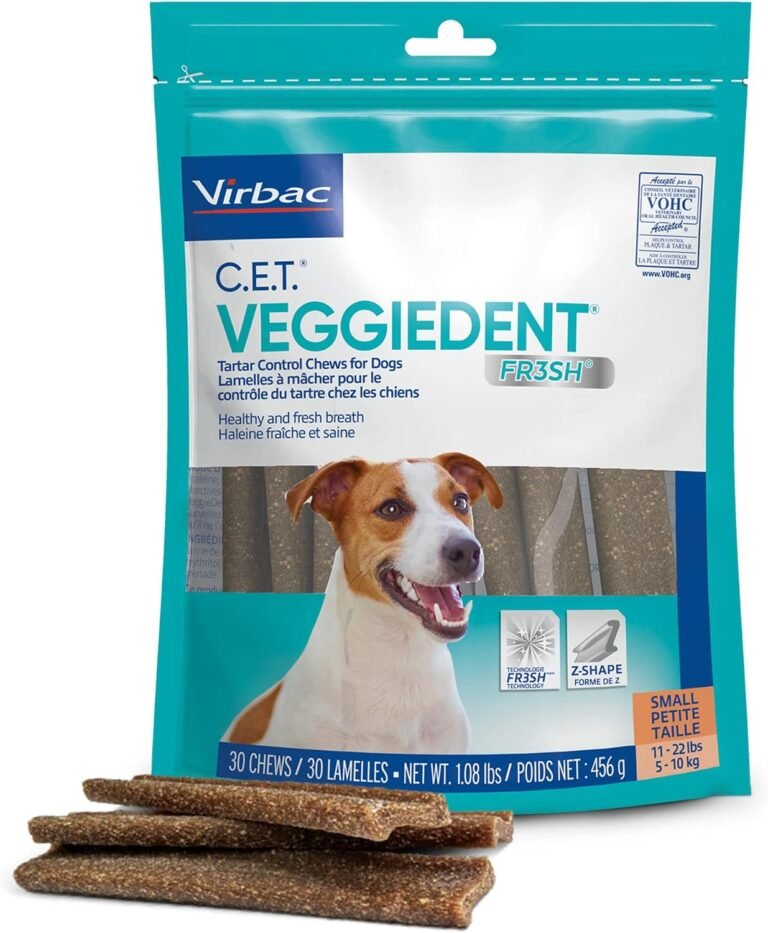
C.E.T. Veggiedent Fr3sh chews are an instructive example: the supplied product information identifies a VOHC seal for tartar control. That wording matters. It should not be quietly expanded into proof that the chew controls every stage of dental disease.
Virbac
C.E.T. Veggiedent Fr3sh Plaque and Tartar Control Chews for Dogs, Small
C.E.T. VEGGIEDENT FR3SH is for daily at-home dental care in dogs. It is intended to help clean the teeth, control plaque and tartar, freshen breath, and support proper digestion as part of a regular oral-care routine.
Affiliate link — we may earn a commission, at no extra cost to you.
Water additives are lower-effort and may suit a dog who will not tolerate brushing. The catch is that a product only helps if the dog drinks treated water normally and receives the correct concentration. Watch for reduced drinking after introducing one; hydration outranks dental convenience. Verify the exact product on the Veterinary Oral Health Council list rather than relying on a general “veterinarian recommended” claim.
Dental diets use kibble texture, shape or formulation to produce a dental effect. They can be practical for dogs already eating dry food, but they work as diets, not as a handful of bonus kibble on top of dinner. Ask your veterinarian whether the food is nutritionally appropriate for your dog and how to transition without increasing total calories.
3. Professional cleaning and the anesthesia-free alternative
Once a dog has substantial tartar, periodontal pockets, loose teeth or painful disease, home products cannot reset the mouth. A veterinary dental procedure under general anesthesia allows a full examination, dental radiographs, scaling below the gumline and treatment or extraction where needed.
The American Veterinary Dental College objects to anesthesia-free scaling because it largely produces a cosmetic cleaning of visible surfaces. It does not allow a thorough examination and cleaning below the gumline, where periodontal disease does its damage. A dog holding still while visible tartar is scraped away is not receiving the equivalent of a veterinary dental procedure.
Key differences
Brushing physically disrupts plaque across the surfaces you reach. Chews rely on tooth contact during chewing, additives rely on formulation and intake, and dental diets depend on being fed in the tested way. None can diagnose a fractured tooth or clean a periodontal pocket.
VOHC acceptance is the useful dividing line within the product categories. The council awards acceptance for demonstrated control of plaque, tartar, or both under its protocols. Check the exact claim beside the exact product. Tartar acceptance does not automatically establish plaque acceptance, and neither means the product treats gingivitis or established periodontal disease.
Best for
- Daily brushing: Dogs who tolerate handling, especially small and brachycephalic breeds with crowded teeth.
- Dental chews: Dogs that chew safely and need an addition to brushing—not a replacement for it.
- Water additives: Dogs that resist mouth handling, provided the additive does not reduce drinking.
- Dental diets: Dogs whose veterinarian agrees the food suits their nutritional and medical needs.
- Professional cleaning: Dogs with existing tartar, gingivitis, pain, loose teeth, periodontal pockets or concerning breath that persists despite home care.
Buying considerations
Before buying any dog dental product, open the VOHC accepted-products list and match the brand, product name, species and size or formulation. Then check whether acceptance is for plaque, tartar or both. A VOHC-style logo in advertising is not enough; lists change, so verify the current entry.
For chews, choose the manufacturer’s size for your dog and supervise. Avoid products hard enough to risk tooth fracture, including antlers, bones and hooves. No chew is worth a slab fracture. Remove pieces that could be swallowed whole, consider obstruction risk in dogs that gulp, and include daily chew calories in the dog’s food allowance.
For additives, confirm the dose and monitor water intake. For diets, check that the food is complete and balanced for the dog’s life stage and ask how much should replace the current ration.
Verdict
The best way to slow dental disease at home is gentle daily brushing with dog-formulated toothpaste. Add a VOHC-accepted chew, water additive or dental diet when it solves a practical gap, but verify whether its acceptance covers plaque, tartar or both.
If tartar and gingivitis are already present, do not shop your way around the cleaning quote. Ask your veterinarian what was found, whether dental radiographs are planned and what treatment your dog actually needs.
Reader questions
Frequently Asked Questions
These are the questions worth settling before changing your dog’s dental routine.
Do dog dental chews work as well as brushing?
No. A VOHC-accepted chew can reduce plaque, tartar or both, but chewing does not provide the controlled, repeated gumline contact of brushing. Use chews as an adjunct and check the product’s precise accepted claim.
How often should I brush my dog’s teeth?
Daily is the best target. Brushing several times a week is still more useful than doing nothing, but infrequent brushing is less likely to keep pace with plaque returning between sessions.
Can brushing remove my dog’s existing tartar?
No. Brushing removes soft plaque but does not safely remove mineralized tartar. Visible tartar, inflamed gums, loose teeth, pain or persistent bad breath calls for a veterinary dental assessment.
Are hard chews better at cleaning teeth?
Harder is not better. Antlers, bones, hooves and similarly rigid chews can fracture teeth. A dental product should have evidence for its claimed effect without requiring your dog to gamble a molar on it.
Does this advice apply to cats?
Not completely. Cats also develop periodontal disease, but they commonly have conditions such as tooth resorption that home products cannot identify or treat. Use cat-specific VOHC listings and seek a veterinary exam for pain, drooling or eating changes.