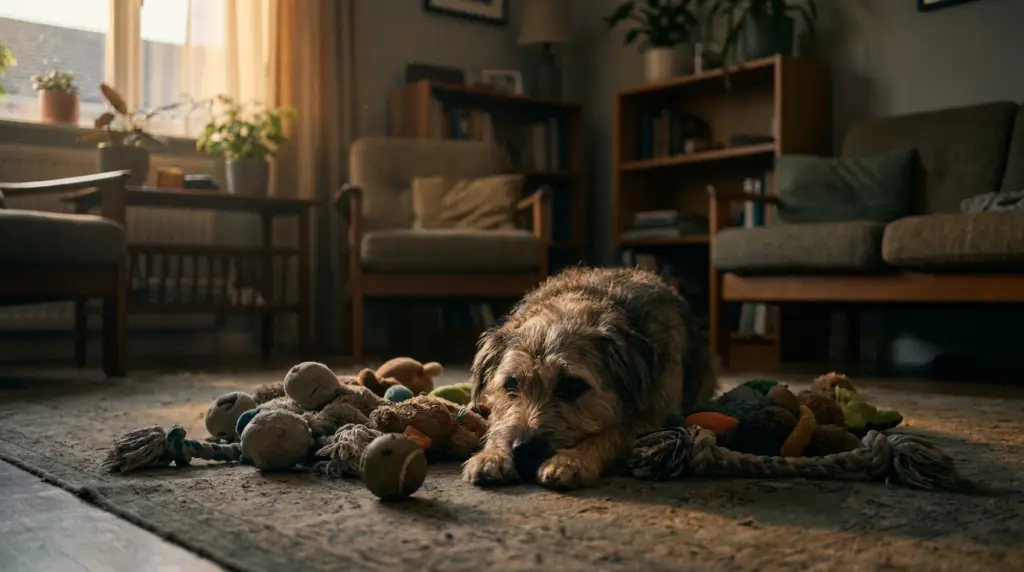
This is a footage-reading guide for dog owners who have come home to damage, a note from the neighbours, or a camera clip they don’t know how to interpret. It covers what to look for, what each pattern suggests, and which single change to make first.
Introduction
A chewed sofa cushion and a scratched-up front door look similar in a photo you take at 6pm. They are not the same problem. One is often a dog with too much energy and nothing to do with it. The other can be a dog in real distress about being alone, and the fixes pull in different directions.
In my clinic years, owners usually arrived with a guess and a purchase already made. The more useful thing was almost always a week of ordinary recordings and someone willing to watch the boring parts.
By the end of this, you’ll know how to film that week, what to look for in the first 20 minutes after you leave, which first change matches what you see, and which signs mean you should skip the home experiments and book a vet appointment.
What you’ll need
- Something that records. An old smartphone propped on a shelf and running a camera or video app is enough. You don’t need live alerts or two-way audio. You need footage you can scrub through later.
- A view of the exit. Choose a spot that shows the door you leave by and, ideally, where your dog usually rests.
- A simple log. Use paper or a notes app. Write down the departure time, how long you were gone, and anything unusual, such as a delivery, a skipped walk, or a storm.
- A week of normal departures. Don’t stage short practice exits yet. You want to see what an ordinary day looks like.
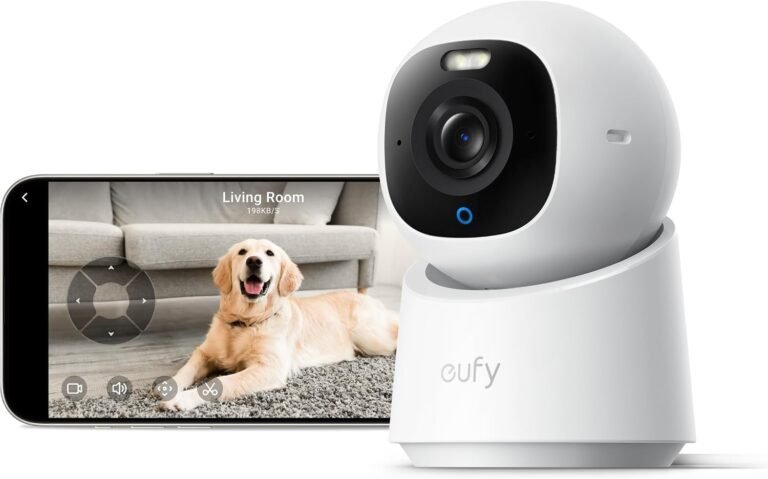
If you don’t have a spare phone and want a dedicated indoor camera, choose one that records locally so you aren’t paying a subscription to see last Tuesday. This one records to a microSD card without a monthly fee for local recording, and it has night vision for evening outings:
Eufy
eufy Security 4K Indoor Camera E30, No Subscription, Work as Pet Camera
The eufy Indoor Cam S350 is for indoor monitoring, including keeping track of pets while they are moving around the home. Its AI tracking, pan-and-tilt movement, high-resolution imaging, night vision, and two-way audio allow owners to observe and interact with pets remotely.
Affiliate link — we may earn a commission, at no extra cost to you.
The catch is that its automatic pet tracking can pan away to follow your dog around the room. For this task, that costs you the one view you actually need. Fix it on the door and leave it there.
Steps
1. Set the camera on the exit and leave it alone. Frame the door and your dog’s usual resting spot in one shot. You’ll know it worked when a test clip shows both without the dog walking out of frame for long stretches.
2. Record a week of real departures, and don’t intervene. Record at least the first 20 minutes of every absence. Don’t watch live, and don’t use the speaker to talk to your dog. Your voice from a box with no person attached can make an unsettled dog worse, and it changes what you’re measuring. You’ve done this step when you have roughly seven clips of ordinary days.
3. Watch the first 20 minutes of each clip for four things.
- Timing. Does anything start within the first few minutes, or only after a long settled stretch?
- Target. Is attention on the door and exits, or on windows, bins, cushions and whatever is lying around?
- Body. Look for relaxed sniffing and play, versus pacing, panting with no heat or exercise to explain it, drooling, trembling, or repeated whining or howling.
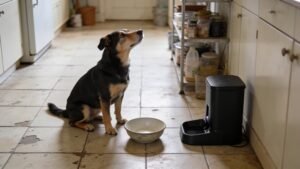
- Settling. Does your dog lie down and stay down? Does food you left get eaten?
Note the answers in your log. You’re done when you can see a pattern across days rather than one dramatic clip.
4. Match what you see to a pattern.
- Pattern 1: Settled, with brief alert episodes. The dog rests, then barks or rushes the window at a passer-by or a noise, then settles again. This usually points to a trigger, not to distress about being alone.
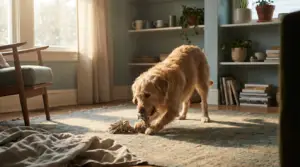
- Pattern 2: Self-entertainment and destruction. Things go quiet at first, and chewing or raiding happens later and is spread around the room. Body language looks loose and busy, not frantic. This often points to under-stimulation.
- Pattern 3: Escalating panic. Distress starts soon after the door closes and is aimed at exits: scratching, chewing door frames, pacing a route, sustained vocalising. The dog won’t settle or eat. This looks more like separation-related distress, and it warrants a vet conversation, not just enrichment.
If your clips mix patterns, go with the most worrying one.
Red flags: contact your vet before experimenting further
- Any injury: bleeding gums, broken teeth or torn nails from chewing doors or crates
- Escape attempts through windows, doors or crate bars
- Drooling, panting or trembling for most of the clip
- Toileting indoors that only happens when the dog is alone
- Refusing food every time you leave
- New behaviour in an older dog, or a sudden change with no change in routine, since pain or other medical causes can show up this way
- Things getting worse week on week
Your vet can rule out medical causes and, where it fits, refer you to a clinical behaviourist.
5. Make one change that matches the pattern.
- Pattern 1: Block the trigger. Put frosted window film on the lower panes, move the sofa away from the window, or run a white-noise machine to soften outside noise.
- Pattern 2: Spend the energy before you go and give the dog a job after you leave. Take a proper sniff-heavy walk, then offer a food-dispensing puzzle or a frozen stuffed feeder put down as you reach the door.
- Pattern 3: Shorten your absences to what the dog can cope with, and talk to your vet. A puzzle that goes untouched is useful information. It tells you the dog is too upset to eat, which is a different problem from boredom.
6. Record another week and compare. It worked if the problem starts later, happens less, or stops, and if settling arrives sooner. If nothing improves, or anything on the red-flag list appears, stop and call your vet.
Common mistakes
Treating the camera as the answer. A camera diagnoses nothing. It shows you behaviour, and the interpretation is yours, ideally checked with your vet. Watching more doesn’t fix anything.
Changing everything at once. If you add a walk, a puzzle and window film in the same week, you won’t know which one helped.
Using enrichment for panic. A food puzzle is a good answer to boredom. A dog in Pattern 3 often won’t touch it. Leaving them alone longer with a better toy can make things worse, which is why shorter absences are often the safer first step.
Practical tips
- Save your clearest clips. A two-minute excerpt is more useful to your vet than your description of it.
- Keep departures low-key. Grab your keys and go, without a long goodbye.
- If your household schedule changed recently, such as a return to the office or a new baby, note that in your log. It matters for interpretation.
- Check whether frozen feeders are lasting. If a stuffed feeder is finished in two minutes, freeze it longer or pack it tighter.
FAQ
How do I know if my dog is bored or anxious when alone? Look at timing and target. Boredom tends to show up later and spread across the room. Distress tends to start soon after you leave and focus on doors and exits, often with pacing, panting or drooling.
My dog barks when left alone. Is that separation anxiety? Not necessarily. Barking at the window that stops once the trigger passes is usually reactive. Continuous barking or howling that starts as you leave is more concerning.
Should I use two-way audio to calm my dog? I wouldn’t, at least during your observation week. It changes the behaviour you’re trying to read, and some dogs get more unsettled by a voice with no person.
Do I need a dedicated dog camera? No. An old smartphone works. If you buy a camera, prioritise local recording over features.
When should I see a vet? See a vet if anything on the red-flag list appears, if the behaviour is new in an older dog, or if a week of the matched change makes no difference.
Conclusion
You should now be able to film a useful week, read the first 20 minutes for timing, target, body and settling, and pick the one change that matches what you see. You should also know which signs mean the next step is your vet, not another gadget. Start with the phone you already have. It’s cheaper, and in practice it tells you more than whatever you were about to buy.
FAQ
How do I know if my dog is bored or anxious when alone?
Look at timing and target. Boredom tends to show up later and spread across the room. Distress tends to start soon after you leave and focus on doors and exits, often with pacing, panting or drooling.
My dog barks when left alone. Is that separation anxiety?
Not necessarily. Barking at the window that stops once the trigger passes is usually reactive. Continuous barking or howling that starts as you leave is more concerning.
Should I use two-way audio to calm my dog?
I wouldn’t, at least during your observation week. It changes the behaviour you’re trying to read, and some dogs get more unsettled by a voice with no person.
Do I need a dedicated dog camera?
No. An old smartphone works. If you buy a camera, prioritise local recording over features.
When should I see a vet?
See a vet if anything on the red-flag list appears, if the behaviour is new in an older dog, or if a week of the matched change makes no difference.