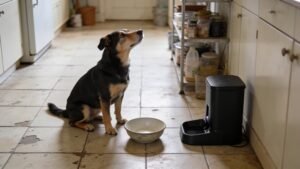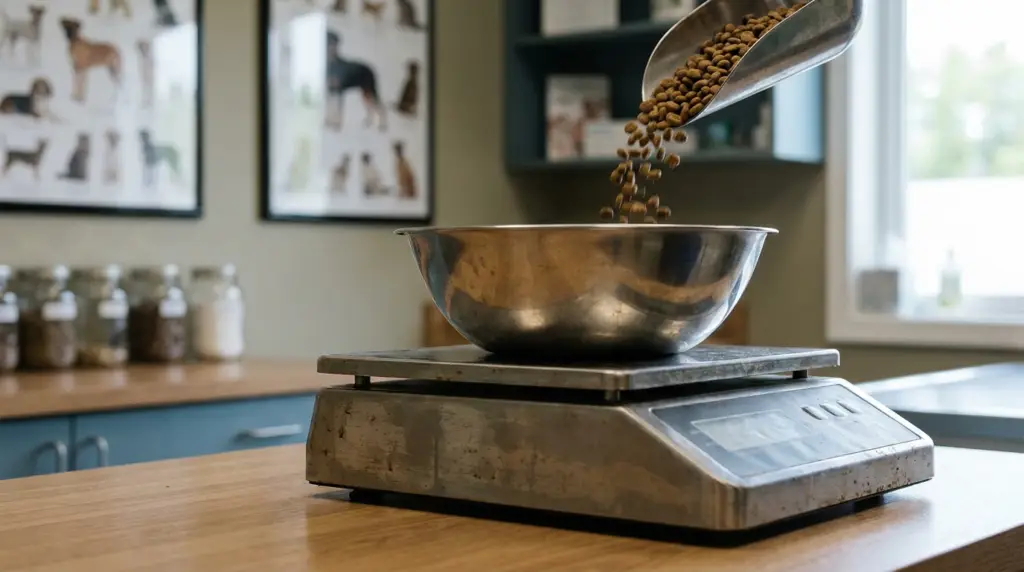
This is a worked method for adult dogs who need to lose weight. It starts with your dog’s target weight, turns that into a daily calorie figure and then into grams of the food in your cupboard, and leaves a set allowance for treats.
Introduction
A Labrador comes in for his annual check. He weighs the same as last year, and the year before. His owner has been "feeding a bit less" the whole time, and she means it. The trouble is that "less" was never measured against anything, so nobody can say what it added up to.
In my clinic years, most stalled diets looked like this. The owner wasn’t short on willpower. The plan had no numbers in it. Weight matters most for dogs with sore joints, because it’s the factor you can change most directly. It also matters for food-motivated breeds, who will take every calorie offered.
By the end of this guide you’ll be able to:
- find the calorie figure on your dog food bag
- work out daily calories for a target weight
- convert those calories into grams per meal
- see what a cube of cheese costs against the day’s allowance
One boundary throughout: your vet sets the target weight and rules out medical causes. The arithmetic here is a starting point you take to that conversation. It doesn’t replace it.
What you’ll need
- Your dog’s current weight, ideally from a vet scale. Bathroom scales are unreliable for small dogs.
- A target weight agreed with your vet.
- The bag your dog’s food came in. You need the calorie statement on it, not the feeding chart.
- A digital kitchen scale that reads in grams. Measuring cups are where most portioning errors start, because a heaped cup and a level cup can differ by a meaningful amount.
Amazon
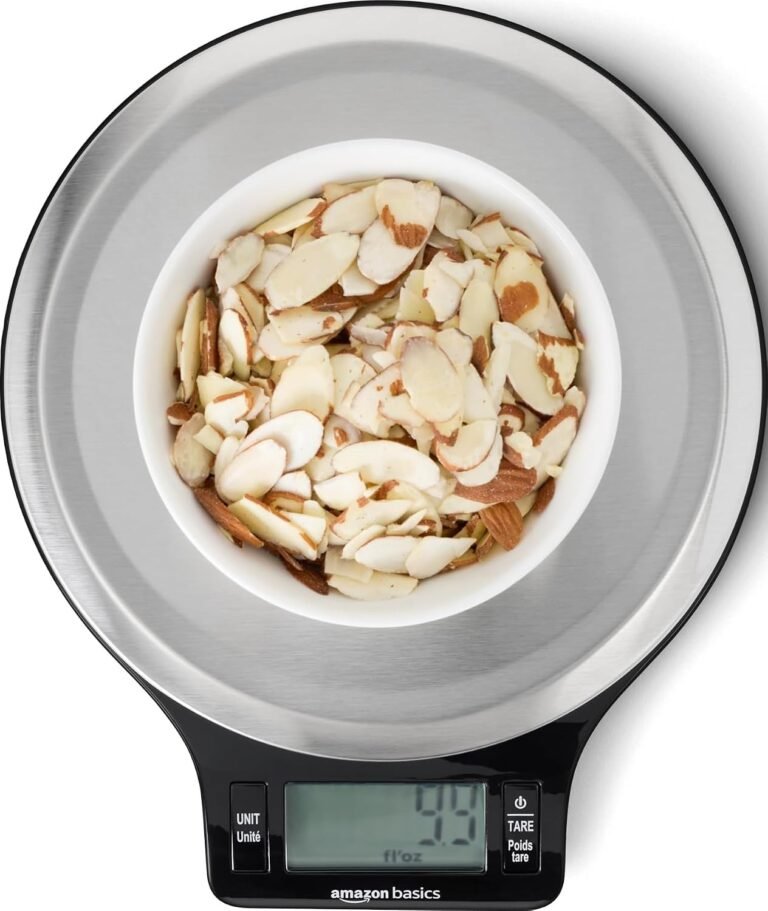
Amazon Basics Digital Kitchen Scale with LCD Display, Tare Function
The Amazon Basics Digital Kitchen Scale is for accurately measuring food ingredients and liquids during everyday cooking, baking, meal preparation, and portion measurement. Its tare function also allows ingredients to be weighed directly in a container without including the container’s weight.
Affiliate link — we may earn a commission, at no extra cost to you.
Any gram-reading scale with a tare function will do the job. This one weighs in grams, has tare so you can zero it with the bowl on top, and starts registering at 2 g. That’s fine for kibble, though too coarse for weighing a single small treat. The catch is that it runs on batteries and shuts itself off, so occasionally you’ll be re-taring mid-scoop.
- A notebook or phone note for weekly weigh-ins.
Steps
1. Check body condition, then agree a target with your vet.
Run your flat palms along your dog’s ribcage with light pressure.
- At a healthy weight, the ribs feel roughly like the back of your hand.
- If you have to press to find them, there’s surplus.
- From above, you should see a waist behind the ribs. From the side, the belly should tuck up.
Vets usually score this on a 9-point scale, where 4–5 is ideal. Ask your vet for a score and a target weight in kilograms. You’ll know this step is done when you have a specific number, not just "he could lose a bit."
2. Find kcal/kg on the label.
US dog food labels carry a calorie statement, usually near the guaranteed analysis. It’s written as "kcal ME/kg" and often also per cup. Use the kcal/kg figure.
Ignore the feeding chart. It’s written for maintenance, usually based on a dog’s current weight and a generic activity level. For a dog who needs to lose weight, that’s the wrong number from the start. You’ve found the right figure when you have a single number, something like 3,600.
3. Calculate calories for the target weight.
A common veterinary starting point is resting energy requirement (RER) at the target weight:
RER = 70 × (target weight in kg)^0.75
You’ll need a calculator with a power key. Your vet may adjust the result up or down for your dog. Treat it as a draft figure.
4. Take treats off the top.
Set aside about 10% of the daily calories for treats. The rest goes to the main food.
5. Convert calories into grams.
Divide kcal/kg by 1,000 to get calories per gram. Then:
grams per day = calories for food ÷ calories per gram
Worked example: a 30kg Labrador
He weighs 30kg and the vet agrees a target of 26kg.
- 26^0.75 ≈ 11.5, so RER ≈ 70 × 11.5 ≈ 805 kcal/day.
- Treat allowance (about 10%): 80 kcal.
- That leaves 725 kcal for food.
- His food is listed at 3,600 kcal/kg, which is 3.6 kcal per gram. (This is an illustrative figure. Use your own bag’s.)
- 725 ÷ 3.6 ≈ 200 g per day.
Worked example: an 8kg terrier
She weighs 8kg and the vet agrees a target of 7kg.
- 7^0.75 ≈ 4.3, so RER ≈ 70 × 4.3 ≈ 300 kcal/day.
- Treat allowance: 30 kcal.
- That leaves 270 kcal for food.
- Her food is listed at 3,800 kcal/kg, which is 3.8 kcal per gram.
- 270 ÷ 3.8 ≈ 71 g per day.
For a dog this small, a heavy-handed scoop can add a meaningful share of her day’s calories without anyone noticing.
6. Divide the daily portion into meals.
Split the grams across however many meals your dog already eats. The Labrador gets 100 g twice a day. The terrier gets about 35 g twice.
Weigh every meal for the first two weeks, until you can see what the right amount looks like. Then keep weighing anyway.
7. Build the treat budget.
Treat labels vary too much for one universal figure, so read the pack, especially for dental chews. A chew sized for a large dog can use up a big share of a small dog’s day.
| Treat | Where to find the calories | Against the terrier’s 30 kcal | |—|—|—| | Dental chew | Calorie statement on the pack, per chew | Check per chew. A large-dog chew may exceed the whole allowance | | Rawhide | Often not labeled | Treat as an unknown and use sparingly | | Cheddar cheese | About 4 kcal per gram | A 10 g cube ≈ 40 kcal, which is over budget | | Her own kibble | Your bag: 3.8 kcal/g | About 8 g of kibble uses the full 30 kcal |
The cheapest treat is kibble taken from the day’s weighed portion. Those calories are already counted.
8. Weigh every two weeks and record it.
This step has worked when the trend points down across several readings. One reading on its own tells you very little.
Common mistakes
- Calculating from current weight. This feeds the dog you have, not the dog you’re aiming for.
- Untracked hands. Two adults each giving a few treats, plus whatever falls off the counter, can match the whole treat budget before anyone has noticed. Agree one person and one treat jar.
- Assuming a dental chew is free. It’s food. Count it. Separately, it doesn’t replace a professional dental cleaning either.
- Cutting hard to speed things up. Very low intake can short a dog on nutrients when the food wasn’t formulated for restriction. That’s where your vet may suggest a therapeutic weight-management diet, which is designed to be fed at reduced calories.
Practical tips
- Use the vet’s scale. Many clinics let you pop in for a quick weigh, which matters most for small dogs, whose progress a bathroom scale may not show.
- Make the food last longer. Scatter part of the kibble on the lawn, or use a slow feeder. The calories stay the same, but your dog gets more searching and chewing out of them.
- Swap begging time for a short walk. If your dog has joint issues, ask your vet what level of activity suits them.
- Photograph your dog from above monthly. The waist often shows up in photos before it shows up on the scale.
FAQ
How fast should my dog lose weight? Roughly 1–2% of body weight per week is the range often quoted, and vets commonly aim near the lower end. For the Labrador, that’s around 0.3 kg a week, so losing 4kg takes months. That’s normal.
What if the weight loss stalls? If there’s no change over two or three weigh-ins, audit for calorie leaks first: treats, other people, the cat’s bowl. If intake is genuinely tight, ask your vet about a further reduction, often around 10%, rather than cutting on your own.
Can I just use an online dog food calorie calculator? Yes, for the calorie figure, provided you enter the target weight. No calculator knows your bag’s kcal/kg, though. The grams step is still yours.
Could a medical problem be behind it? It can be. Hypothyroidism is one cause vets consider, and some medications affect appetite or weight. If your dog isn’t losing weight on a measured intake, or is gaining without explanation, that’s a vet conversation, not a reason to cut harder.
Should I switch to a weight-management food? Not necessarily. Measuring the current food often works. A therapeutic diet is worth discussing with your vet if your dog needs to lose a lot of weight or stays hungry on reduced portions.
Conclusion
You can now take a vet-agreed target weight and turn it into a daily calorie figure, grams per meal of your dog’s own food, and a treat allowance with real numbers on it. You also know where those numbers usually go wrong.
Start this week by weighing what you already feed for a few days, before changing anything. Most owners find the gap between what they think they feed and what the dog actually gets is where the weight has been coming from. Bring those numbers to your vet, agree the target, and then let the scale run the plan.
FAQ
How fast should my dog lose weight?
Roughly 1–2% of body weight per week is the range often quoted, and vets commonly aim near the lower end. For a 30kg Labrador, that’s around 0.3 kg a week, so losing 4kg takes months. That’s normal.
What if the weight loss stalls?
If there’s no change over two or three weigh-ins, audit for calorie leaks first: treats, other people, the cat’s bowl. If intake is genuinely tight, ask your vet about a further reduction, often around 10%, rather than cutting on your own.
Can I just use an online dog food calorie calculator?
Yes, for the calorie figure, provided you enter the target weight. No calculator knows your bag’s kcal/kg, though. The grams step is still yours.
Could a medical problem be behind it?
It can be. Hypothyroidism is one cause vets consider, and some medications affect appetite or weight. If your dog isn’t losing weight on a measured intake, or is gaining without explanation, that’s a vet conversation, not a reason to cut harder.
Should I switch to a weight-management food?
Not necessarily. Measuring the current food often works. A therapeutic diet is worth discussing with your vet if your dog needs to lose a lot of weight or stays hungry on reduced portions.